Address
304 North Cardinal St.
Dorchester Center, MA 02124
Work Hours
Monday to Friday: 7AM - 7PM
Weekend: 10AM - 5PM

Address
304 North Cardinal St.
Dorchester Center, MA 02124
Work Hours
Monday to Friday: 7AM - 7PM
Weekend: 10AM - 5PM

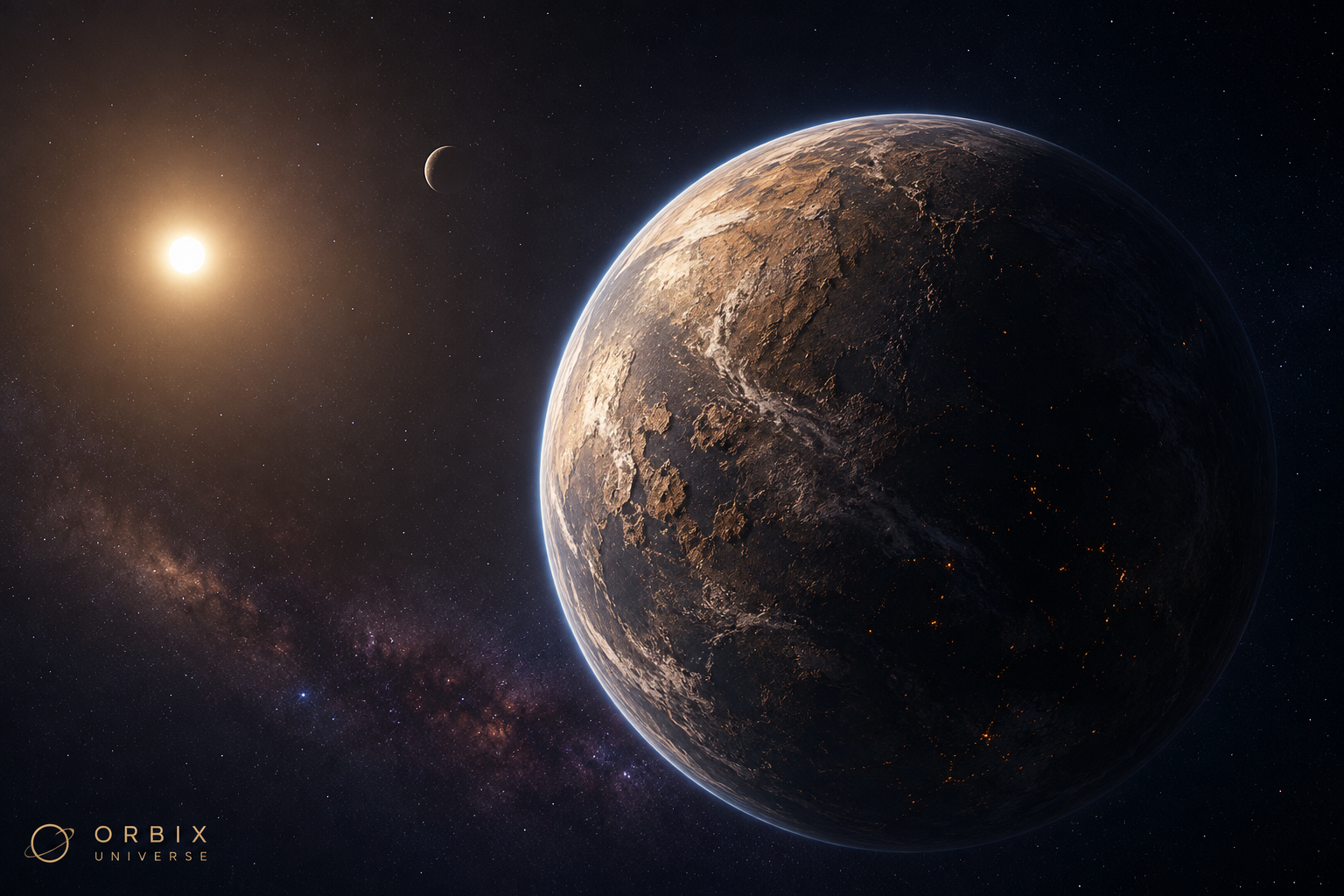
Discover how scientists find “Another Earth” – exoplanets, which worlds could be habitable, what JWST has revealed, and what the latest discoveries mean for the search for alien life.
Right now, on a small blue planet orbiting an unremarkable yellow star, a handful of scientists are staring at flickers of starlight that are billions of times fainter than what your eyes could ever detect — and using them to answer one of humanity’s oldest questions: are we alone?
This isn’t science fiction. As of mid-2026, astronomers have confirmed more than 6,000 planets orbiting other stars — worlds we call exoplanets. And in July 2026, one of them made headlines around the world: for the first time ever, scientists confirmed an atmosphere on a rocky planet sitting inside its star’s “habitable zone.”Stick around — the story behind that headline is stranger, and more carefully hedged, than most of the coverage let on.
Let’s start simple. “Exo” is Greek for “outside.” An exoplanet is just a planet that orbits a star other than our Sun — one of the hundreds of billions of other suns scattered across the Milky Way.Here’s the wild part: humanity has only known for certain that other stars have planets since 1995. That’s it. Three decades. Before that, every model of how planets form was based on a sample size of exactly one solar system — ours.
Then came 51 Pegasi b, nicknamed “Dimidium,” the first planet ever confirmed orbiting a Sun-like star. It was a “hot Jupiter” — a gas giant baking just 0.05 AU from its star, closer than Mercury is to our Sun, completing an orbit in just over four days. Nothing like it existed anywhere in our own solar system, and it directly contradicted the prevailing theory that gas giants could only form far from their star and stay there. It earned discoverers Michel Mayor and Didier Queloz a share of the 2019 Nobel Prize in Physics.Since then, the exoplanet count has exploded — from roughly 340 known worlds when NASA’s Kepler telescope launched in 2009, to over 6,000 confirmed today, with thousands more candidates waiting in the wings.
Here’s the problem that makes exoplanet science so remarkable: stars are almost incomprehensibly brighter than the planets orbiting them. NASA has compared the challenge to spotting a firefly flickering beside a spotlight — except the “spotlight” is actually more like a lighthouse beam, and you’re standing miles away trying to catch a glimpse of the tiny flicker beside it.
An Earth-like planet circling a Sun-like star at Earth’s distance is roughly ten billion times fainter than its star. Even the James Webb Space Telescope — humanity’s most powerful space observatory — usually can’t just “look” and see a planet directly.
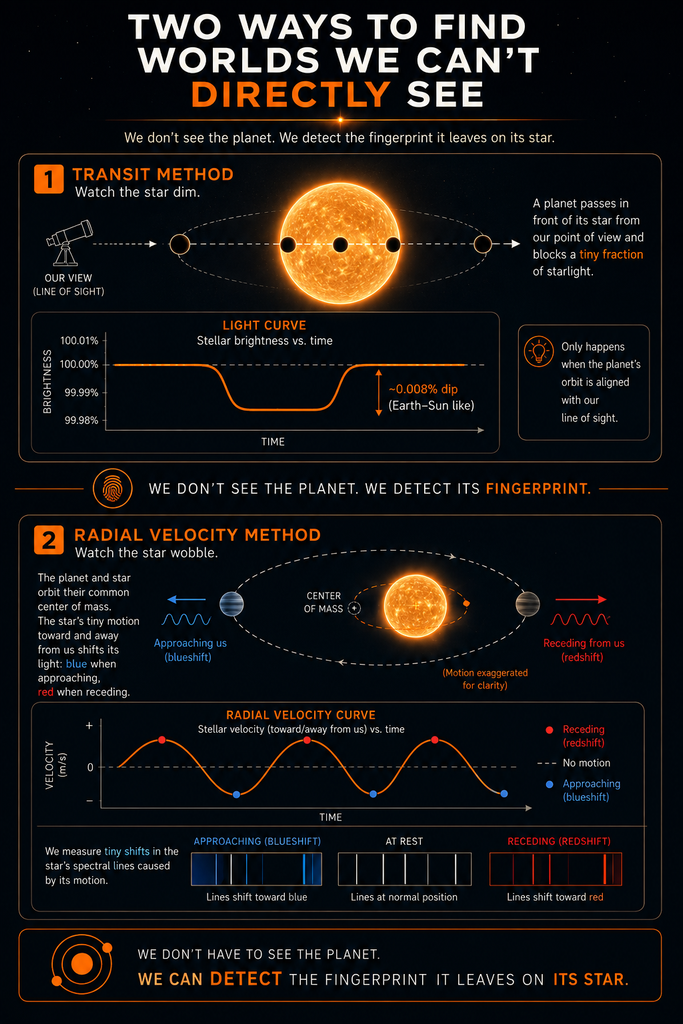
So scientists became detectives instead. They stopped trying to see planets and started looking for the clues planets leave behind:
The Wobble (Radial Velocity Method): A planet’s gravity tugs its star into a tiny orbit of its own, causing the star’s light to shift color ever so slightly — blue as it approaches us, red as it recedes. This is how 51 Pegasi b was found in 1995.
The Dimming (Transit Photometry Method): When a planet crosses in front of its star from our point of view, it blocks a tiny sliver of light — a dip so small that an Earth-sized planet crossing a Sun-sized star dims it by only about 0.008%. This is how missions like Kepler and TESS have found the vast majority of known exoplanets.
Pulsar Timing: In 1992, astronomers found the very first confirmed exoplanets — not around a normal star, but around the crushed corpse of one: a spinning neutron star called a pulsar. Tiny, regular timing shifts in its radio pulses revealed invisible planets orbiting it.
Gravitational Microlensing: Straight out of Einstein’s playbook — when a foreground star drifts in front of a background star, its gravity acts like a magnifying glass. If that foreground star has a planet, a second little “blip” of brightness reveals it. Each event is a one-time, unrepeatable cosmic coincidence.
Direct Imaging: The rarest and most cinematic method — actually photographing a planet as a separate point of light, using instruments called coronagraphs that physically block the glare of the host star. Think of it less like blocking the sun with your thumb and more like trying to spot a candle flame next to a lighthouse from another city — it requires suppressing starlight by a factor of roughly ten billion, one of the hardest engineering problems in astronomy. (A newer variant of this technique, without even a visible point of light, shows up later in this article.)
Every single one of these approaches is basically a workaround for the same brutal fact: we mostly can’t see these worlds. We can only see their fingerprints.
Out of more than 6,000 confirmed exoplanets, a handful have become genuine celebrities in the astronomy world. Here are the ones worth knowing.
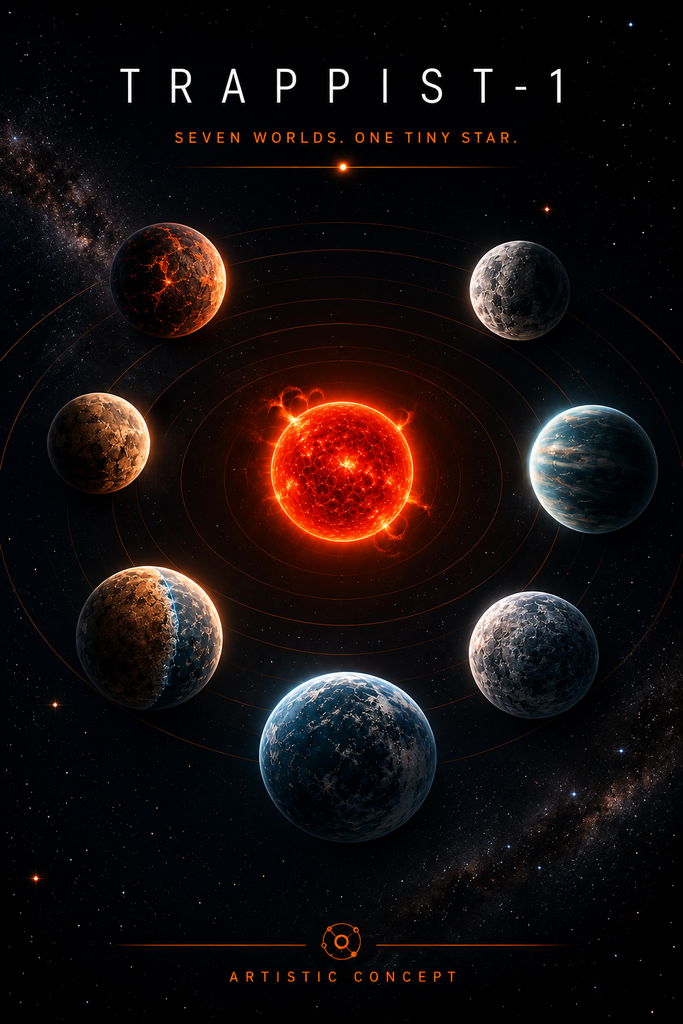
Announced in 2017, the TRAPPIST-1 system packs seven roughly Earth-sized rocky planets into an orbital space smaller than Mercury’s path around our Sun — all orbiting a small, dim red dwarf star about 40 light-years away. Stand on one of these planets, and your neighboring worlds would look bigger in the sky than our Moon does from Earth.Three or four of these planets sit in or near the habitable zone. But JWST observations have delivered a mixed verdict: the two innermost planets, b and c, appear to be bare, airless rock — their atmospheres likely stripped away by their star’s frequent flares. TRAPPIST-1e, the most promising candidate, remains an open case, with astronomers still collecting the transit data needed for a definitive answer.
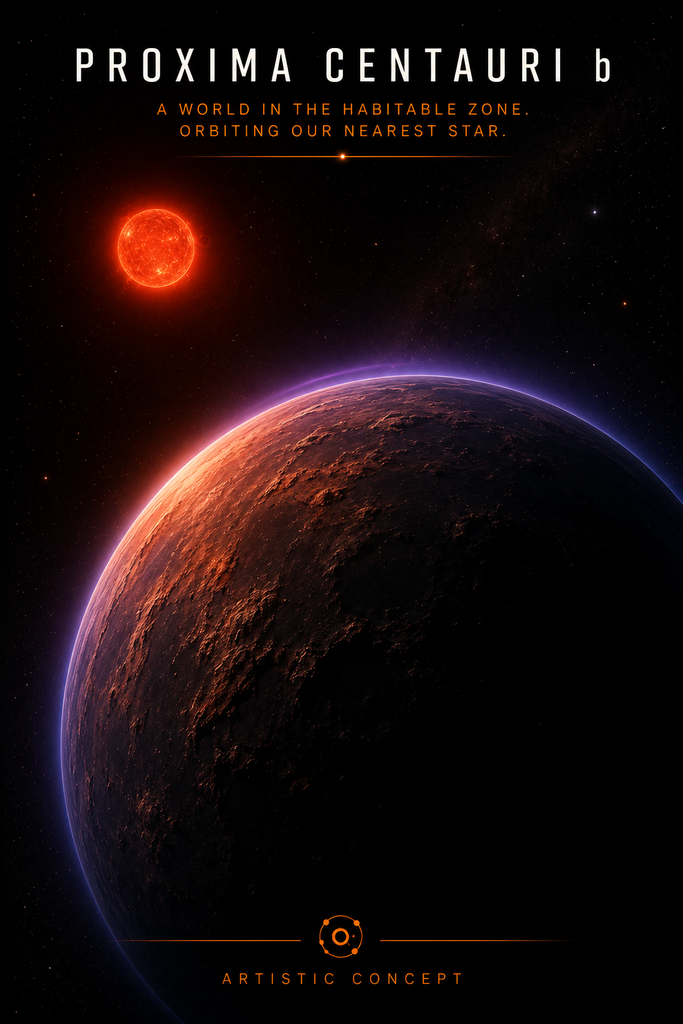
At just 4.2 light-years away, Proxima b orbits the nearest star to our Sun. It sits in its star’s habitable zone — but Proxima Centauri is a violent, flare-prone red dwarf with a stellar wind roughly 2,000 times stronger than what Earth experiences from the Sun. Whether any atmosphere could survive that onslaught remains completely unknown.
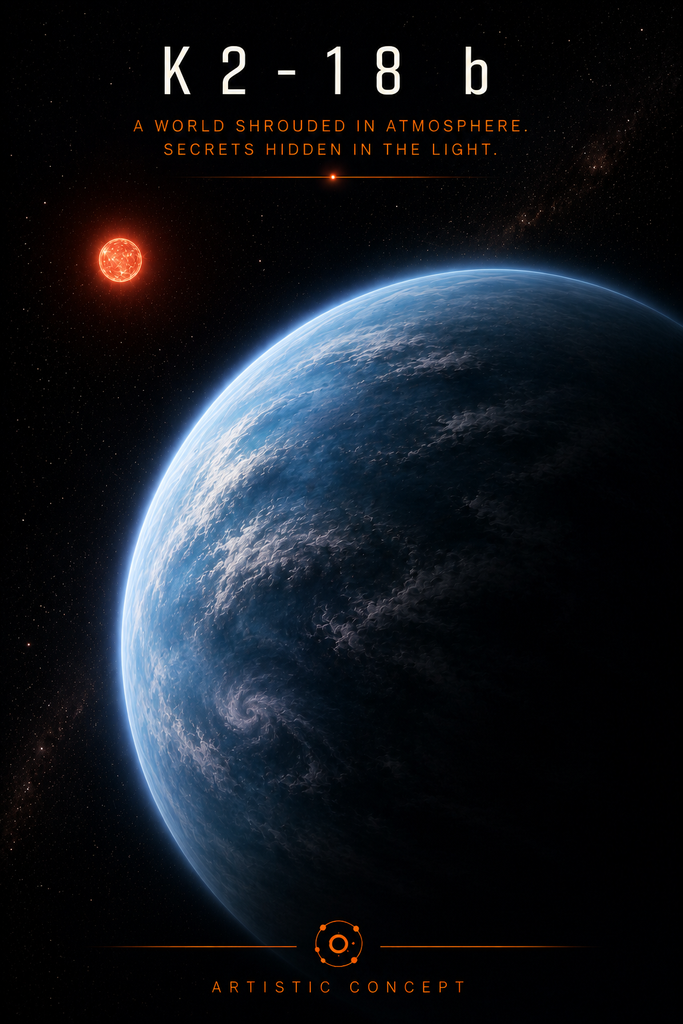
If you want a masterclass in how real science actually works, look no further than K2-18b. This sub-Neptune, orbiting a red dwarf 124 light-years away, has been called one of the loudest exoplanet controversies of the mid-2020s.In 2023, JWST detected methane and carbon dioxide in its atmosphere — solid, uncontested findings. But buried in that same data was a tantalizing, low-confidence hint of dimethyl sulfide (DMS), a molecule that on Earth is produced almost exclusively by marine microbes. In April 2025, follow-up observations strengthened that signal to roughly “3-sigma” confidence.Here’s the catch: astronomy’s gold standard for a confirmed discovery is “5-sigma” — a probability threshold thousands of times stricter than 3-sigma. Within days of the April 2025 announcement, cosmochemists publicly pointed out that DMS is known to form abiotically in comets and interstellar clouds, meaning its mere presence can’t be treated as proof of life. The scrutiny only intensified from there: an independent reanalysis using 60 different data-processing pipelines — actually posted a few months before the April claim, using earlier data — had already found no reliable evidence for DMS at all. Then, in July 2025, a NASA JPL-led team went further still, showing that DMS-like molecules can actually form through pure chemistry — no biology required — in hydrogen-rich atmospheres like K2-18b’s.Even the original researcher, Nikku Madhusudhan, has been candid that his team never claimed a confirmed detection — just “moderate evidence.” As of today, K2-18b’s biosignature question remains genuinely, publicly unresolved. It’s not a cover-up or a debunking — it’s science working exactly as it’s supposed to: bold claim, rigorous scrutiny, honest revision.
This is the big one. On July 16, 2026, a Harvard-led team announced something that had never happened before: the first confirmed atmosphere on a rocky planet sitting inside its star’s habitable zone. One important caveat up front, before anything else: this is not a life detection, and it’s not even a full atmosphere confirmation — only helium in the planet’s outer atmosphere has been confirmed so far.With that caveat in place, here’s why it’s still a big deal. Using a ground-based telescope in Chile, researchers detected helium gas escaping from LHS 1140b’s upper atmosphere — present during a 2024 transit, then mysteriously absent during a 2025 observation, suggesting the planet’s atmospheric behavior changes over time, likely tied to its star’s activity. LHS 1140b, just 48 light-years away, is now considered by its discovery team to be the strongest real-world candidate for an “ocean world” — a rocky planet potentially covered in liquid or ice-capped water.It’s evidence that the planet has any atmosphere at all — which, after a decade of trying, is itself a monumental first. As the discovery team put it, an atmosphere is essential for a planet to support life as we understand it, but having one is a long way from proving anyone’s home.
Here’s a strange coincidence: one day before the LHS 1140b announcement, on July 15, 2026, astronomers revealed a third planet in the Beta Pictoris system — a young star already famous in exoplanet circles as one of the first places a planet was ever directly photographed, back when “Beta Pictoris b” became a benchmark for testing coronagraph technology.Beta Pictoris d is a different kind of milestone. Every direct-imaging discovery earlier in this article — HR 8799’s four planets, HIP 65426b — was found the old-fashioned way: spot a separate point of light next to the star. Beta Pictoris d wasn’t found that way at all. Instead, JWST picked out the planet’s unique atmospheric chemical fingerprint buried inside the glare of the star and its surrounding debris disk — no clean point of light required.
This is the single most important thing to understand if you want to follow exoplanet news without getting misled.
The habitable zone (sometimes called the “Goldilocks zone”) is simply the range of distances from a star where liquid water could theoretically exist on a planet’s surface — not too hot, not too cold. But sitting in that zone is a necessary condition, not a guarantee.
Consider three real examples: Kepler-20e is Earth-sized but scorching hot with no chance of holding an atmosphere. Kepler-22b sits comfortably in its habitable zone but is more than twice Earth’s size — probably a gassy world with no solid surface at all. Kepler-186f checks both boxes but orbits a dim red dwarf under radically different radiation conditions than our Sun.
To keep things scientifically honest, researchers now use a three-tier framework:
“Earth-like” — similar in size and likely composition to Earth. Says nothing about surface conditions.
“Potentially habitable” — sits in the habitable zone with plausible rocky composition. A location claim, not a confirmation.
“Confirmed habitable” — verified liquid water and survivable surface conditions.
As of today, zero exoplanets occupy that third tier. Earth is still the only confirmed habitable — and inhabited — planet in the known universe. Any headline that blurs “potentially habitable” into “Earth 2.0” is oversimplifying the science.
The search for life beyond Earth comes down to biosignatures — chemical fingerprints in a planet’s atmosphere that hint at biological activity. Scientists look for gases like oxygen, methane, and, controversially, DMS.
But here’s the humbling truth: virtually every proposed biosignature gas can also form without any life involved at all. Oxygen was once considered a near-bulletproof sign of biology — until researchers discovered it can also be generated abiotically through certain star-driven chemical processes, especially around red dwarfs. Methane can come from geology, not just microbes.
That’s why astrobiologists increasingly rely on a “weight of evidence” approach: looking for combinations of gases that are chemically out of equilibrium in ways that are hard to explain without ongoing biological replenishment, and watching for seasonal changes that static chemistry alone struggles to produce. No single molecule, however exciting the headline, is proof on its own.
For most of exoplanet history, scientists could measure a planet’s size and rough mass — but almost nothing about what it was actually made of. JWST changed that overnight.Its core trick is called transmission spectroscopy: as a planet transits its star, a sliver of starlight filters through the planet’s atmosphere (if it has one) on its way to us. Different molecules absorb very specific wavelengths of that light, leaving behind a kind of chemical barcode. By reading which colors are missing, astronomers can identify water vapor, carbon dioxide, methane, sulfur dioxide, and more — from hundreds of light-years away.JWST’s greatest hits so far include the first unambiguous carbon dioxide detection in an exoplanet atmosphere (WASP-39b), the first detection of active photochemistry happening on a distant world, and the first-ever silicate cloud detection on a planet nicknamed for its “sideways glass rain” (HD 189733b, which really does rain glass horizontally in 7,000 km/h winds). Still, even JWST hasn’t yet definitively confirmed an atmosphere on any small, cool, rocky world — that frontier is only just beginning to open.What Comes Next: The Next 20 Years
The search for another Earth is about to get a serious upgrade. Here’s what’s realistically on the calendar:
Nancy Grace Roman Space Telescope (NASA, targeting late 2026 launch) will hunt for thousands of exoplanets using gravitational microlensing, including free-floating “rogue” planets with no host star at all.
PLATO (ESA, with a launch window that has been cited anywhere from late 2026 to March 2027 depending on the source — worth double-checking closer to the date) is purpose-built to find true Earth analogs orbiting Sun-like stars, a gap neither Kepler nor TESS fully covered.
ARIEL (ESA, targeted for the early 2030s) will survey the atmospheres of roughly 1,000 exoplanets — turning atmospheric science from individual case studies into a true statistical census.
The Extremely Large Telescope (ESO, first light expected 2029–2030), a ground-based 39-meter mirror in Chile. ESO itself has said the ELT could become the first telescope capable of detecting signs of life beyond our solar system — a genuinely exciting claim, though worth remembering it’s the building agency’s own framing of its flagship project, not an independent assessment.
The Habitable Worlds Observatory (NASA’s flagship after Roman) aims to directly image at least 25 potentially habitable worlds — but isn’t expected before the 2040s, and its funding trajectory remains genuinely uncertain.
Realistically, within the next decade we’re likely to have a much richer statistical picture of which nearby rocky worlds are worth the most attention. Whether any single discovery in that window will amount to a confirmed biosignature is genuinely unknown — and anyone who tells you otherwise is getting ahead of the science.
We’ve gone from knowing about exactly one planetary system — ours — to cataloging more than 6,000 worlds in three decades. We’ve found planets that rain glass, planets locked in death spirals into their own stars, and planets that might be quietly hiding oceans deeper than anything on Earth. And in 2026, for the first time, we confirmed an atmosphere on a rocky world sitting in the “just right” zone.
We haven’t found another Earth. We haven’t found life. But every year, the tools get sharper, the candidate list gets shorter and more promising, and the question “are we alone?” edges a little closer to becoming answerable — rather than just askable.
That, more than any single headline, is the real story here.
Proxima Centauri b is the closest known exoplanet to Earth, located about 4.2 light-years away. It orbits Proxima Centauri, the nearest star to the Sun. Proxima Centauri b is roughly Earth-sized and lies within its star’s habitable zone, but scientists have not confirmed whether it has an atmosphere, liquid water, or conditions suitable for life.
No exoplanet has been confirmed to have Earth-like surface conditions or to support life. Astronomers have discovered several potentially habitable worlds, including Proxima Centauri b, TRAPPIST-1e, and LHS 1140 b. However, being in a star’s habitable zone does not prove that a planet has liquid water, a suitable atmosphere, or conditions that could support life.
No. There is currently no confirmed evidence of alien life on K2-18b. Observations have detected methane and carbon dioxide in its atmosphere, while claims about the possible presence of dimethyl sulfide (DMS), a molecule associated with life on Earth, remain scientifically debated. Detecting a potentially interesting molecule is not the same as detecting life, and scientists have not established that K2-18b is inhabited.
Beta Pictoris d is a giant exoplanet orbiting the young star Beta Pictoris, making it the third known planet in the system. NASA’s James Webb Space Telescope announced its discovery on July 15, 2026. Instead of finding the planet through conventional direct imaging alone, researchers detected the chemical fingerprint of its atmosphere using spectroscopy. The observations revealed carbon monoxide absorption lines and helped confirm that the planet is gravitationally bound to the Beta Pictoris system
NASA’s Kepler Space Telescope is one of the most prolific exoplanet-hunting missions ever conducted and discovered thousands of planets and candidates. NASA’s TESS mission has also discovered hundreds of confirmed exoplanets by searching for the tiny dips in starlight caused when planets transit their stars. The James Webb Space Telescope has a different primary role: it specializes in studying and characterizing exoplanets, particularly their atmospheres and chemical composition, rather than competing with Kepler and TESS simply by number of discoveries
Sources drawn from NASA, ESA, JPL, STScI, and peer-reviewed journals including Nature, Science, and The Astrophysical Journal Letters.
