Address
304 North Cardinal St.
Dorchester Center, MA 02124
Work Hours
Monday to Friday: 7AM - 7PM
Weekend: 10AM - 5PM

Address
304 North Cardinal St.
Dorchester Center, MA 02124
Work Hours
Monday to Friday: 7AM - 7PM
Weekend: 10AM - 5PM

Trace the universe's 13.8-billion-year story, from the hot Big Bang and the first atoms to the birth of stars and galaxies, cosmic expansion and the mysteries that remain.
The Story of Cosmic Origins
A Journey Through 13.8 Billion Years of Cosmic History
The universe was not always filled with stars and galaxies. It has expanded and changed over billions of years, evolving from an early hot, dense state into the vast cosmic landscape we observe today.
Light takes time to travel. The sunlight that warms Earth left the Sun about eight minutes ago. Light from distant stars and galaxies may have travelled for thousands, millions or even billions of years before reaching our telescopes.
When astronomers observe distant galaxies, they are seeing them as they were in the past. The deeper we look into space, the further back through cosmic history we can investigate. The universe is not only a place; it is a story written across time.
A simplified illustration of light reaching us from different distances and different cosmic times.
The leading scientific model says that the observable universe evolved from an extremely hot, dense early state about 13.8 billion years ago. Space itself has expanded, stretching the wavelengths of light travelling through it and cooling the universe as it grew.
The Big Bang was not an explosion of matter into pre-existing empty space from a central point. In the standard picture, the expansion happens throughout space: on sufficiently large scales, distant galaxies move away from one another as the universe expands.
A conceptual illustration of cosmic evolution, not a scientific map or a literal depiction of the universe’s earliest moments.
It describes the universe’s evolution from an early hot, dense phase and is supported by several independent lines of evidence. It does not, by itself, tell us with certainty what happened at the very first instant, whether there was a prior phase, or why there is a universe at all.
Cosmic history spans an enormous range of conditions. The timeline below highlights major milestones; the earliest stages are described by physics that remains an active area of research.
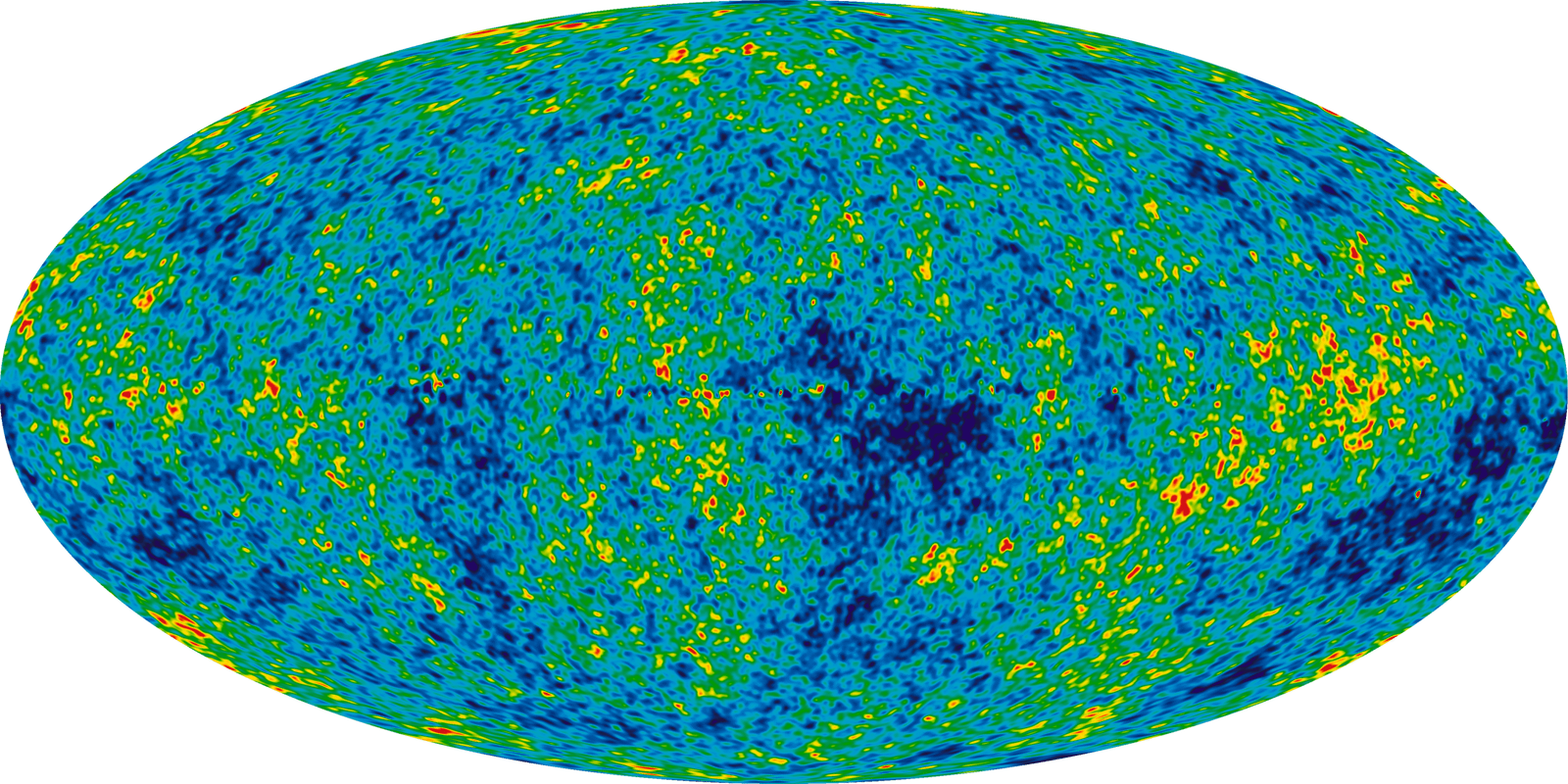
The cosmic microwave background is a faint afterglow from the early universe. This is an illustrative pattern, not actual observational data.
The cosmic microwave background (CMB) is radiation released when the universe became cool enough for neutral atoms to form and photons to travel freely. As the universe expanded, this light was stretched into microwave wavelengths.
Today the CMB fills the sky and has a temperature of about 2.7 kelvin. Tiny temperature differences across it reveal variations in the early universe that later grew, under gravity, into stars, galaxies and the cosmic web.
After the CMB was released, the universe entered a long period without stars. Gravity gradually amplified small differences in the distribution of matter. Gas collected in dense regions, and the first stars eventually formed from mostly hydrogen and helium.
Small early density differences grew as gravity pulled gas and dark matter into increasingly structured regions.
Dense gas clouds collapsed and heated until nuclear fusion began in the first generations of stars.
Stars, gas and dark matter gathered into galaxies that grew and changed through mergers and ongoing star formation.
The early universe produced mostly hydrogen and helium, with tiny amounts of lithium. Many of the heavier elements were made later inside stars through nuclear fusion and through other stellar processes.
When stars age, explode or merge with compact companions, they can release newly formed elements into space. That enriched material becomes part of later generations of stars, planets and eventually living worlds. The carbon in cells, oxygen in the air and iron in Earth’s core have a cosmic history.
A simplified stellar story. Different elements form through different processes and at different stages of stellar evolution.
In the 1920s, observations showed that distant galaxies are generally receding from us, with more distant galaxies typically showing greater recession speeds. This relationship became a key part of the evidence that the universe is expanding.
Expansion does not mean that every object is being stretched. Gravity and other forces hold together many local systems, such as galaxies, solar systems and atoms. On the largest scales, however, the distances between unbound galaxies increase as space expands.
Expansion increases large-scale distances between galaxies that are not gravitationally bound to one another.
Observations of distant supernovae in the late 1990s revealed that the expansion of the universe is accelerating. The name dark energy is used for the unknown component or physical explanation associated with this acceleration in the standard cosmological model.
Its nature remains one of the biggest open questions in cosmology. It may be associated with a cosmological constant, or it may point to physics that we do not yet understand. It is not the same as dark matter, which is inferred mainly through gravitational effects on matter and cosmic structure.
The Big Bang model is not based on one observation. Its strength comes from several independent lines of evidence that fit together into a coherent account of cosmic evolution.
Cosmology has built a powerful picture of the universe’s history, but the deepest beginning remains beyond a complete scientific explanation. Observations and theory continue to refine the story.
Scientists combine observations from telescopes, particle experiments and precise measurements of the cosmic microwave background. They compare these observations with mathematical models and computer simulations to test how the universe could have evolved.
Observe galaxies and supernovae across cosmic distances and look back toward earlier eras.
Map tiny temperature and polarization patterns in the CMB to test models of the early universe.
Recreate some early-universe conditions in experiments and test the fundamental ingredients of matter.
The history of the universe is also the history of the materials that make life possible. The early universe supplied the simplest elements. Stars forged many of the heavier ones. Generations of stellar activity enriched the gas from which planets and, eventually, living worlds could form.
When we study cosmic origins, we are not only asking how galaxies appeared. We are tracing the long chain of events that made our own existence possible—and discovering how much of that story remains unfinished.
Measurements within the standard cosmological model indicate that the universe is about 13.8 billion years old.
The Big Bang describes the evolution of the observable universe from an early hot, dense state. It was not an explosion from one point into pre-existing empty space.
We do not know. Our current theories do not provide a confirmed answer about whether a meaningful “before” existed or what physical conditions may have preceded the hot Big Bang phase.
It is ancient radiation released when the universe cooled enough for neutral atoms to form and light to travel freely, about 380,000 years after the beginning of the hot Big Bang phase.
Gravity drew gas into denser regions. As clouds collapsed and heated, the first stars eventually became hot enough for nuclear fusion to begin.
Yes. Observations show that the universe continues to expand on large scales, and the expansion is currently accelerating.
Its far future depends on the nature of dark energy and the evolution of cosmic expansion. The leading model predicts continued expansion, but the ultimate fate remains tied to unanswered physics.
Cosmic history connects the laws of nature with the structure and contents of the universe. Continue exploring:
For further reading, start with these resources from NASA: