Address
304 North Cardinal St.
Dorchester Center, MA 02124
Work Hours
Monday to Friday: 7AM - 7PM
Weekend: 10AM - 5PM

Address
304 North Cardinal St.
Dorchester Center, MA 02124
Work Hours
Monday to Friday: 7AM - 7PM
Weekend: 10AM - 5PM

Discover how rockets reach orbit, how spacecraft operate in space, and how the United States, India, Russia and China are building launch vehicles and spacecraft for satellites, crews and deep-space exploration.
A rocket must fight gravity, cross the atmosphere and build enough speed to enter orbit. Then, long after its engines fall silent, a spacecraft must navigate, communicate, survive and sometimes bring its crew home. These are two different machines—and together they turn the ambition to explore space into something humanity can actually do.
Every satellite image, astronaut mission, lunar landing and distant planetary encounter begins with an engineering problem: how do you move something from Earth into space, and keep it working there? The answer is not one miraculous engine. It is a chain of carefully coordinated systems, built by teams across the world.
A rocket is a launch vehicle: it produces thrust by expelling propellant and accelerates a payload away from Earth. A spacecraft is the vehicle or machine that operates in space. It may carry people, scientific instruments, cargo or communications equipment. Some spacecraft travel independently; others remain in orbit as satellites, dock with stations, land on another world or fly past a distant object.
Provides the energy and velocity needed to reach the intended orbit or departure trajectory. Its stages, engines, tanks, guidance system and payload fairing are designed around the launch mission.
Separates from the launch vehicle and performs its mission. It needs power, communication, navigation, thermal control, computers and—when required—its own propulsion and landing or return systems.
It does not push against air. A rocket engine throws hot exhaust backwards at high speed; the rocket gains forward momentum. This is Newton’s third law in action, and conservation of momentum explains why the principle works even in a vacuum.
Inside a chemical rocket engine, fuel and an oxidiser react in a combustion chamber. The hot, high-pressure gas expands through a nozzle, converting thermal energy into a fast exhaust stream. The engine’s thrust depends on the mass of propellant expelled each second and the speed at which it leaves, along with pressure effects at the nozzle exit.
The challenge is that a rocket must carry both fuel and oxidiser. It cannot rely on atmospheric oxygen once it reaches thin air or space. That makes propellant mass, engine efficiency and the rocket’s total mass central to every design decision.
At liftoff, a rocket carries enormous quantities of propellant. As it burns that propellant, empty tanks and engines become dead weight. Staging solves part of the problem: when a stage has done its job, it is discarded, allowing the remaining vehicle to accelerate a smaller mass.
Many launchers use two or more stages. Some ignite strap-on boosters at liftoff; others use a central core and upper stage. The exact sequence varies. Staging is not automatically better in every design: extra separation events add mechanical complexity, but shedding empty structure can greatly improve performance.
Fuel and oxidiser are stored together in a solid propellant grain. Solid motors can provide high thrust and relatively simple storage, making them useful as boosters. Once ignited, however, they are difficult or impossible to throttle or shut down in the way many liquid engines can.
Fuel and oxidiser are stored separately and fed into the engine. Liquid engines can often be throttled, shut down and restarted depending on design. Pumps, valves, tanks and plumbing add complexity, but offer important control options.
Uses very cold liquid propellants, commonly liquid hydrogen and liquid oxygen. These can deliver high efficiency, especially in upper stages, but require insulation, careful handling and demanding ground systems.
Uses electrical energy to accelerate a propellant, often producing very low thrust but high efficiency. It is useful for long-duration satellite station-keeping and deep-space cruise, not for lifting a rocket from Earth’s surface.
There is no universally best engine. A launcher needs powerful thrust to escape Earth’s gravity well; a spacecraft in orbit may instead benefit from a highly efficient engine that operates gently for months. Mission destination, payload mass, time, cost and control requirements determine the choice.
Crossing the edge of the atmosphere is only part of the journey. To remain in low Earth orbit, a spacecraft must travel sideways at roughly 7.8 kilometres per second, with the exact orbital speed depending on altitude. It is continuously falling toward Earth, but its sideways motion means the planet’s surface curves away beneath it.
That is why a rocket’s job is not simply to go up. It must build the right horizontal velocity and place the payload on the right trajectory. Reaching the Moon, Mars or another destination requires additional energy and precise timing. A spacecraft may coast for long periods, make small course corrections and use gravity assists to reshape its path.
Once the launch vehicle releases it, the spacecraft becomes a self-contained machine. Its design depends on its mission, but most spacecraft combine several core systems:
The frame, tanks, antennas, solar-array hinges, robotic arms, docking hardware and deployment mechanisms hold the vehicle together and allow it to operate.
Solar panels convert sunlight into electricity; batteries store energy for eclipses and peak demand. Some deep-space missions use radioisotope power systems where sunlight is too weak or unreliable.
Sensors, star trackers, gyroscopes, sun sensors, computers and thrusters help determine orientation, position and movement. Navigation may combine radio tracking, optical measurements and onboard estimation.
Insulation, radiators, heaters and carefully chosen surface coatings keep instruments and electronics within operating temperatures as the spacecraft moves between sunlight and shadow.
Antennas and radio systems send commands, telemetry and science data between the spacecraft and ground stations. Signal delay grows with distance, so deep-space probes need increasing autonomy.
Scientific instruments, cameras, telescopes, sample tools, crew cabins or cargo are the reason the spacecraft exists. The payload drives many of the design choices.
| Spacecraft type | What it does | Examples |
|---|---|---|
| Satellites | Remain in orbit for communications, navigation, Earth observation, weather, science or technology demonstrations. | Navigation and Earth-observation satellites |
| Crewed capsules | Carry astronauts, support life during flight and return crews through the atmosphere. | Orion, Soyuz, Shenzhou, Crew Dragon |
| Cargo spacecraft | Deliver supplies, fuel, equipment and experiments to orbital stations. | Progress, Tianzhou, Cargo Dragon |
| Space probes | Explore planets, moons, asteroids, comets and the space between them. | Voyager, Juno, Hayabusa2, Chang’e and Tianwen missions |
| Landers and rovers | Reach a surface, conduct measurements and sometimes travel across terrain. | Vikram, Chang’e landers, Mars rovers |
| Space telescopes | Observe the universe from above much or all of Earth’s atmosphere. | Hubble, James Webb, X-ray and solar observatories |
Space engineering is not a single national story. Different countries have built launch systems and spacecraft around their own scientific priorities, industrial capabilities, geography, budgets and strategic goals. The examples below are a guide to major programmes—not a league table. Publicly announced capabilities and vehicle configurations can change, and payload figures are meaningful only when the target orbit and rocket variant are specified.
The United States combines government-developed systems with a large commercial launch and spacecraft sector. NASA’s Space Launch System (SLS) and Orion are designed for crewed missions beyond low Earth orbit. Commercial vehicles such as Falcon 9 and spacecraft such as Dragon have reshaped access to orbit and cargo or crew transport. The country also operates a wide range of scientific probes, Earth-observation satellites and space telescopes.
The important distinction is that NASA is not the entire US space industry. Government agencies set mission requirements and operate science programmes, while private companies develop and provide many launch and transportation services. This mix creates capability, competition and new questions about cost, reliance and long-term sustainability.
Reference: NASA — Spaceships and Rockets.
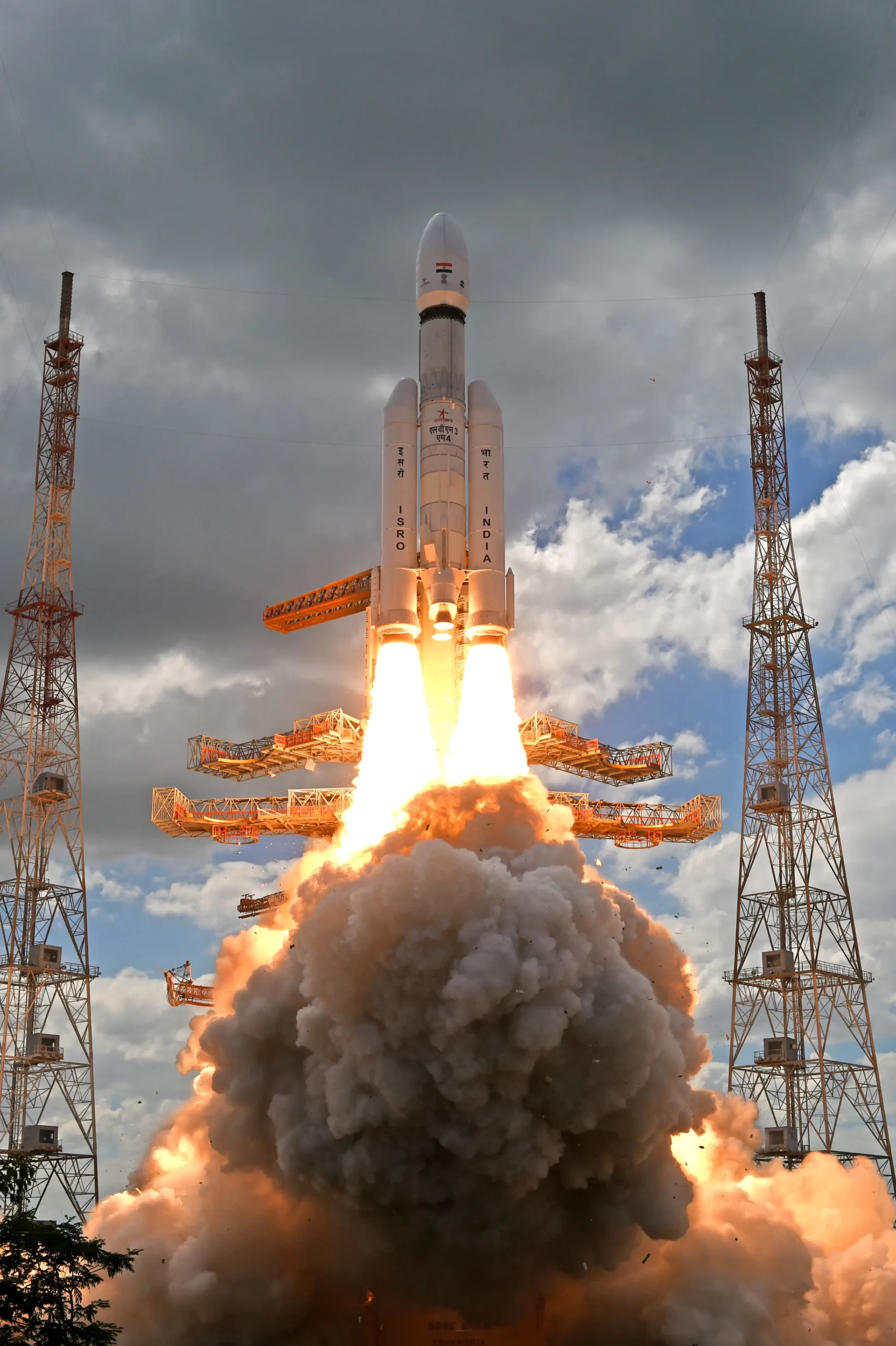
India’s launch family includes the Polar Satellite Launch Vehicle (PSLV), Geosynchronous Satellite Launch Vehicle (GSLV), Launch Vehicle Mark-3 (LVM3) and Small Satellite Launch Vehicle (SSLV). PSLV has supported Earth-observation, science and commercial missions; GSLV introduced an indigenous cryogenic upper stage; and LVM3 provides heavier lift, including the launch of Chandrayaan-3.
LVM3 uses two solid S200 boosters, a liquid L110 core and a cryogenic C25 upper stage. That combination is a useful example of how a single launcher can integrate different propulsion technologies. India is also developing the human-rated launch system for Gaganyaan, while its future launch-vehicle plans include next-generation and reusable technologies. Development programmes should not be confused with operational vehicles: planned capability is not the same as a launcher already flying routine missions.
India’s private space sector is also emerging, with companies developing small launch vehicles and propulsion systems. The result is a space ecosystem that is moving beyond a purely government-operated model while retaining ISRO as a central technical institution.
References: ISRO — Launchers · ISRO — LVM3 technical overview.
Russia’s spaceflight capabilities grew from the Soviet programme, which pioneered the first artificial satellite and the first human spaceflight. The Soyuz launch vehicle family remains central to crew and cargo transportation, while the Soyuz spacecraft carries cosmonauts and international partners. The uncrewed Progress spacecraft delivers supplies and propellant to the International Space Station.
Russia has also developed the Angara family, including the lighter Angara 1.2 and heavy Angara-A5, intended to provide a more modern launcher architecture and reduce dependence on older systems. The Proton family has played a major historical role in heavy launches. Current Russian spaceflight should be understood as a combination of mature systems, modernisation programmes and projects whose schedules and operational status can evolve.
Baikonur is geographically in Kazakhstan, not Russia, although Russia has historically operated it under lease. Russia also operates launch facilities on its own territory, including Plesetsk and Vostochny. This distinction matters when describing where a rocket launches versus which country operates it.
References: NASA — Soyuz launcher background · Roscosmos.
China’s Long March family spans a wide range of launch vehicles. Long March 2F is associated with crewed Shenzhou missions; Long March 7 has supported Tianzhou cargo flights; and the heavy-lift Long March 5 family has enabled large space-station modules and major lunar and planetary missions. These are not interchangeable rockets: each is configured for different payloads, trajectories and mission demands.
China’s Shenzhou spacecraft transports crews, while Tianzhou spacecraft resupply the Tiangong space station. The station itself is a modular orbital complex, not a launch vehicle. China’s robotic exploration programme includes Chang’e lunar missions and Tianwen planetary missions. Its future crewed lunar architecture is under development; proposed systems should be described as planned or in development until they become operational.
References: China Manned Space Agency · CNSA — Launch vehicles.
Traditional rockets discarded most or all of their stages after one flight. Reusable launch systems attempt to recover and refurbish some hardware, especially the first stage. A booster may return to a landing site or a drone ship, while other designs investigate wings, parachutes or different recovery methods.
Reusability can reduce the cost of hardware per flight, but it does not make launches free. Engines and structures need inspection, refurbishment, transport and testing. A reusable system succeeds economically only when its turnaround time, reliability and refurbishment costs make sense for the launch market it serves.
India, the United States, China and other spacefaring nations are investigating different reusable or partially reusable approaches. A prototype test, a technology demonstrator and an operational reusable orbital launcher are three very different milestones.
Every kilogram added to a spacecraft can demand more propellant, larger tanks or a more capable launcher. Engineers constantly trade payload, redundancy, lifetime and cost.
Launch vehicles combine extreme vibration, heat, pressure and tightly timed events. Human-rated systems require additional fault tolerance, abort capability, testing and certification.
Radiation, vacuum, micrometeoroids, thermal cycling and long periods without repair can degrade hardware. Spacecraft must be designed for an environment that is difficult to reproduce fully on Earth.
More satellites mean more coordination, collision avoidance and end-of-life planning. Spacecraft operators need responsible disposal or passivation strategies to reduce long-lived debris.
Future launch systems may combine reusable boosters, advanced engines, in-space refuelling, autonomous rendezvous and larger orbital infrastructure. Electric propulsion may help move cargo slowly and efficiently. Nuclear thermal or nuclear electric propulsion could offer advantages for some deep-space missions, but these technologies face substantial engineering, safety, regulatory and political challenges.
For human exploration, rockets and spacecraft are only the beginning. Long-duration missions will need radiation protection, life-support systems, reliable power, spare parts, medical capability and the ability to repair equipment far from Earth. A vehicle that can reach Mars is not automatically a system that can keep people alive there.
That is the deeper story: humanity is learning to build machines that do more than visit space. We are learning how to operate beyond the protective environment of our home planet. Every new engine, capsule, probe and orbital platform is another experiment in how far our curiosity—and our engineering—can take us.
A rocket is a launch vehicle that accelerates a payload. A spacecraft is the vehicle or machine that operates in space, such as a satellite, crew capsule, cargo craft, probe or lander.
They expel exhaust backwards and gain forward momentum. They do not need air to push against; they carry both fuel and oxidiser so combustion can occur without atmospheric oxygen.
Discarding empty tanks and engines reduces the mass that later stages must accelerate. This helps a rocket reach the high velocities needed for orbit or deep-space trajectories.
Several countries have independent launch and spacecraft capabilities. The United States, India, Russia and China each operate or develop multiple launch vehicles and spacecraft, with different levels of capability and mission focus.
ISRO’s principal launch vehicle families include PSLV, GSLV and LVM3, alongside the Small Satellite Launch Vehicle. Their payload capabilities and target orbits differ, so they are selected according to mission requirements.
It is a liquid rocket engine that uses propellants stored at very low temperatures, commonly liquid hydrogen and liquid oxygen. Cryogenic upper stages can provide high efficiency but require complex storage and handling systems.
They can reduce the cost of replacing major hardware, but savings depend on inspection, refurbishment, recovery, turnaround time and flight rate. Reusability does not eliminate operational costs.
Spacecraft need a launch system to leave Earth, but once in space they can use chemical or electric propulsion, gravity assists, solar sails in some concepts, or coast along an orbital trajectory. The best method depends on the mission.
Rockets and spacecraft are the hardware behind humanity’s journey outward. Explore the larger missions they make possible and the technologies that will shape the next era of spaceflight.