Address
304 North Cardinal St.
Dorchester Center, MA 02124
Work Hours
Monday to Friday: 7AM - 7PM
Weekend: 10AM - 5PM

Address
304 North Cardinal St.
Dorchester Center, MA 02124
Work Hours
Monday to Friday: 7AM - 7PM
Weekend: 10AM - 5PM

Explore exoplanets beyond our Solar System, how astronomers discover distant worlds, what makes a planet potentially habitable, and how scientists search for biosignatures without confusing possibility with proof of life.
Across the Milky Way, stars host worlds unlike anything in our Solar System: giant planets orbiting closer to their stars than Mercury, rocky worlds around faint red suns, and planets where clouds may contain unfamiliar chemistry. The search for exoplanets is changing our picture of planetary systems. The search for life asks a harder question: could any of those worlds be habitable—and does life actually exist there?
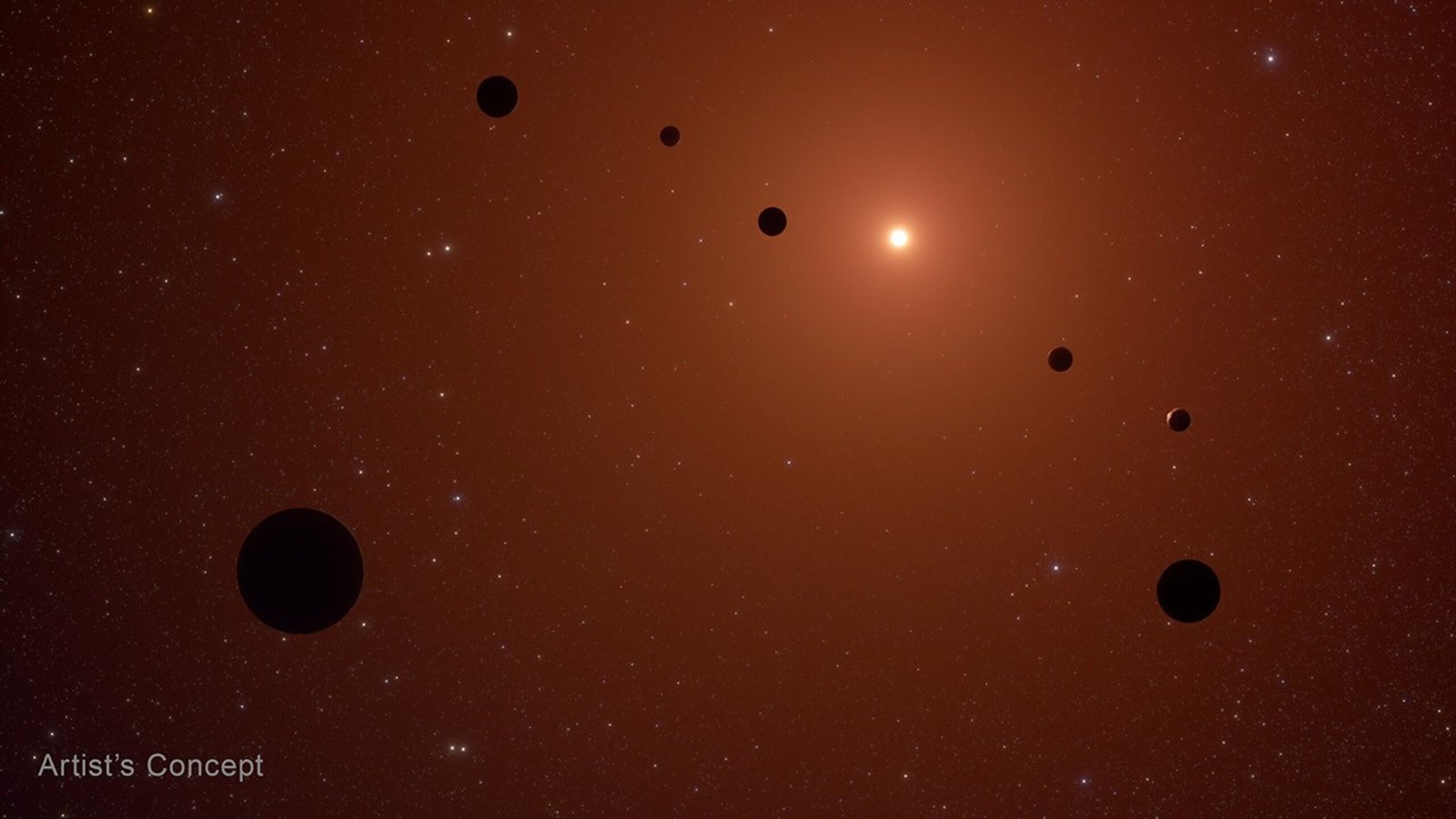
An exoplanet is a planet that orbits a star beyond the Sun. For centuries, planets around other stars were a compelling possibility rather than confirmed discoveries. That changed in the 1990s, when astronomers established the first detections of planets orbiting Sun-like stars. Since then, thousands of exoplanets have been confirmed, revealing planetary systems with a remarkable range of sizes, orbits and compositions.
Our Solar System is only one example of how planets can be arranged. Some systems contain giant planets on extremely short orbits; others have several planets packed close to their star. Many known planets have no close analogue in our own planetary neighbourhood. Each discovery helps astronomers test ideas about how planets form, migrate and evolve.
Exoplanets are diverse. A planet’s measured radius alone does not always reveal whether it is rocky, gaseous or rich in water and other volatile materials.
Gas giants orbiting extremely close to their stars, sometimes completing an orbit in just a few days. Their high temperatures and unusual orbits challenged early assumptions about how planetary systems form.
Planets more massive than Earth but generally less massive than Neptune. The name describes a broad mass range, not a guarantee that a planet has continents, oceans or an Earth-like environment.
Worlds smaller than Neptune but often larger than Earth, commonly understood to have substantial gaseous or volatile envelopes. Their interiors and atmospheres can differ widely.
Worlds with solid surfaces, potentially composed of silicate rock and metal. Some may orbit in regions where surface liquid water could be possible if atmospheric conditions are suitable.
Some planets may contain large amounts of water or other volatile materials. But a planet’s density and radius rarely tell us by themselves whether it has a global ocean, deep high-pressure ice or a thick atmosphere.
Objects with planetary masses that are not currently bound to a host star. They may have been ejected from planetary systems or formed through other processes; their origins remain under study.
Most exoplanets are too faint and too close to their bright host stars to be photographed directly. Astronomers therefore use indirect techniques: they measure the planet’s effect on its star or the light travelling from the star towards us. Each method reveals different properties and favours different kinds of planetary systems.
When a planet crosses in front of its star from our viewpoint, it blocks a tiny fraction of the starlight. The repeating dip reveals the planet’s orbital period and, with other information, its radius.
A planet’s gravity makes its star move slightly. Astronomers detect this motion through shifts in the star’s spectrum caused by the Doppler effect. The method provides a measure related to the planet’s minimum mass.
Specialised instruments suppress the glare of a star to capture light from a planet. This is difficult, but particularly useful for some young, hot planets on wide orbits and for studying their light.
When a foreground star passes in front of a more distant background star, its gravity magnifies the background light. A planet around the foreground star can create a brief additional signal.
Instead of measuring a star’s motion towards or away from us, astrometry measures its tiny movement across the sky. This can reveal the gravitational tug of orbiting planets.
When two or more methods observe the same system, astronomers can constrain a planet’s mass, radius, density and orbit more effectively than with one measurement alone.
The transit method measures a small, repeating reduction in starlight. The depth of the dip helps estimate the planet’s size relative to its star.
One useful starting point is the habitable zone: the range of distances from a star where a planet with a suitable atmosphere could, in principle, maintain liquid water on its surface. It is sometimes called the “Goldilocks zone”, but that nickname can create a misleading impression. Being in the habitable zone does not mean a planet is inhabited—or even that it has liquid water.
Atmospheric pressure and composition, clouds, reflective ice, oceans, geological activity, a planet’s rotation and the behaviour of its host star can all affect climate. A planet outside the conventional habitable zone might have subsurface liquid water, while one inside it could be dry, airless or overheated.
The habitable zone is a modelled range, not a map of confirmed oceans or life. Its boundaries depend on the star’s energy and assumptions about planetary atmospheres.
Many detected exoplanets orbit red dwarfs, the small and relatively cool stars known as M dwarfs. Their habitable zones lie closer in than the Sun’s, making transits more frequent for some systems. But red dwarfs can produce energetic flares and strong ultraviolet or X-ray activity, which may alter planetary atmospheres. Whether a particular planet can retain an atmosphere depends on its full history and properties.
Astrobiology investigates the origin, evolution, distribution and future of life in the universe. For exoplanets, one promising approach is to study a planet’s atmosphere. When a planet transits its star, some starlight can pass through the planet’s atmospheric edge. Molecules absorb particular wavelengths, leaving patterns that telescopes can analyse.
Scientists look for gases such as water vapour, carbon dioxide, methane and oxygen. But no single gas is a universal proof of biology. A molecule may be produced by geological processes, photochemistry or interactions between a planet and its star. The same gas can have different meanings in different planetary environments.
A biosignature is a substance, pattern or phenomenon that could indicate life. A convincing interpretation requires understanding the planet’s environment and testing non-biological explanations.
Temperature, pressure, stellar radiation, clouds and the presence of other gases can change how a molecule should be interpreted. Multiple lines of evidence are stronger than one isolated detection.
Scientists also consider whether technology could produce detectable signals, such as unusual radio emissions or other large-scale effects. No technosignature has been confirmed as evidence of extraterrestrial technology.
Life might exist beneath ice, underground or in environments that are difficult to observe remotely. The search therefore also includes nearby worlds in our own Solar System.
Evidence check: No life beyond Earth has been confirmed. A potentially habitable planet, an interesting atmospheric molecule and a verified biosignature are three very different levels of evidence.
Exoplanets are not the only places relevant to the search for life. Several worlds in our own Solar System offer environments worth investigating. They are much closer than exoplanets, so robotic spacecraft can study their surfaces, chemistry and—in some cases—subsurface environments directly.
Ancient river channels, lake deposits and minerals formed in water show that Mars once had environments that could have been more habitable than its present surface. Rovers search for signs of ancient habitability and preserve samples for possible future return.
Jupiter’s moon Europa has a fractured icy surface and strong evidence for a global ocean beneath its ice shell. Its ocean is a compelling target for studying the chemistry and energy sources that could support life.
Saturn’s small moon Enceladus ejects plumes of water-rich material from its south polar region. Spacecraft have detected salts and organic compounds in plume material, making its subsurface ocean a major astrobiology target.
Saturn’s largest moon has a dense atmosphere and lakes and seas of liquid methane and ethane on its surface. Its chemistry offers a natural laboratory for studying complex organic processes, although its surface environment is extremely cold.
These destinations belong to our Solar System, not the exoplanet catalogue. They help scientists investigate what life might require and how broadly habitable environments could occur.
Space telescopes and ground-based observatories are moving beyond simply counting planets. Missions such as NASA’s TESS survey transiting planets around nearby bright stars; the James Webb Space Telescope can study selected exoplanet atmospheres; and observatories under development aim to characterise smaller, potentially rocky worlds in greater detail.
Future progress will depend on better instruments, repeated observations and careful interpretation. Measuring a planet’s atmosphere is challenging: the planet’s signal is tiny compared with its star, clouds and hazes can obscure features, and stellar activity can imitate or complicate atmospheric signals.
Ultimately, astronomers want to move from discovering distant worlds to understanding their climates, chemistry and potential habitability. Confirming life would likely require several independent observations that converge on an explanation difficult to reproduce without biology.
These are open questions, not invitations to treat speculation as discovery. The search is scientifically powerful precisely because observations can rule out possibilities as well as reveal new ones.
Thousands have been confirmed, and the total changes as new candidates are verified. The confirmed catalogue is only a fraction of the planets thought to exist in the Milky Way.
A number of small planets have been found in or near the habitable zones of their stars. But “Earth-like” can mean different things, and we have not yet confirmed a true Earth twin with a known surface environment and life.
No. It means surface liquid water may be possible under suitable atmospheric conditions. It does not establish that water exists or that life has emerged.
In a limited number of cases, yes. Direct imaging works best for planets that are relatively bright, young and widely separated from their stars. Most exoplanets are detected indirectly.
Astronomers have reported atmospheric molecules in some exoplanets, but detections and interpretations vary in confidence. Even a robust detection of a molecule such as methane or oxygen would not, by itself, prove life.
At present, there is no confirmed evidence of life beyond Earth. Researchers continue to investigate potentially habitable environments and possible biosignatures.
Yes, in principle. Moons such as Europa and Enceladus may have subsurface oceans, and these environments are important targets in the search for potentially habitable conditions.
A biosignature is evidence that could point to biological activity, such as a particular atmospheric pattern. A technosignature is evidence that could point to technology, such as an artificial signal. Neither category has produced a confirmed detection of extraterrestrial life or technology.
The search for life connects planetary science with stellar astronomy, space missions and the conditions that make worlds habitable. Explore these related subjects to follow the bigger picture.
For further reading, start with these resources from NASA: