Address
304 North Cardinal St.
Dorchester Center, MA 02124
Work Hours
Monday to Friday: 7AM - 7PM
Weekend: 10AM - 5PM

Address
304 North Cardinal St.
Dorchester Center, MA 02124
Work Hours
Monday to Friday: 7AM - 7PM
Weekend: 10AM - 5PM

Explore the diverse worlds of the Solar System, from the rocky terrestrial planets and giant planets to icy moons, hidden oceans, atmospheres and the search for habitable environments.
A planet is not just a point moving around a star. It is a world—with landscapes, weather, chemistry, a deep interior and, sometimes, moons of its own. Across the Solar System, worlds range from scorched rocky deserts to giant planets wrapped in turbulent atmospheres, and from icy satellites hiding oceans to places that challenge our ideas about habitability.
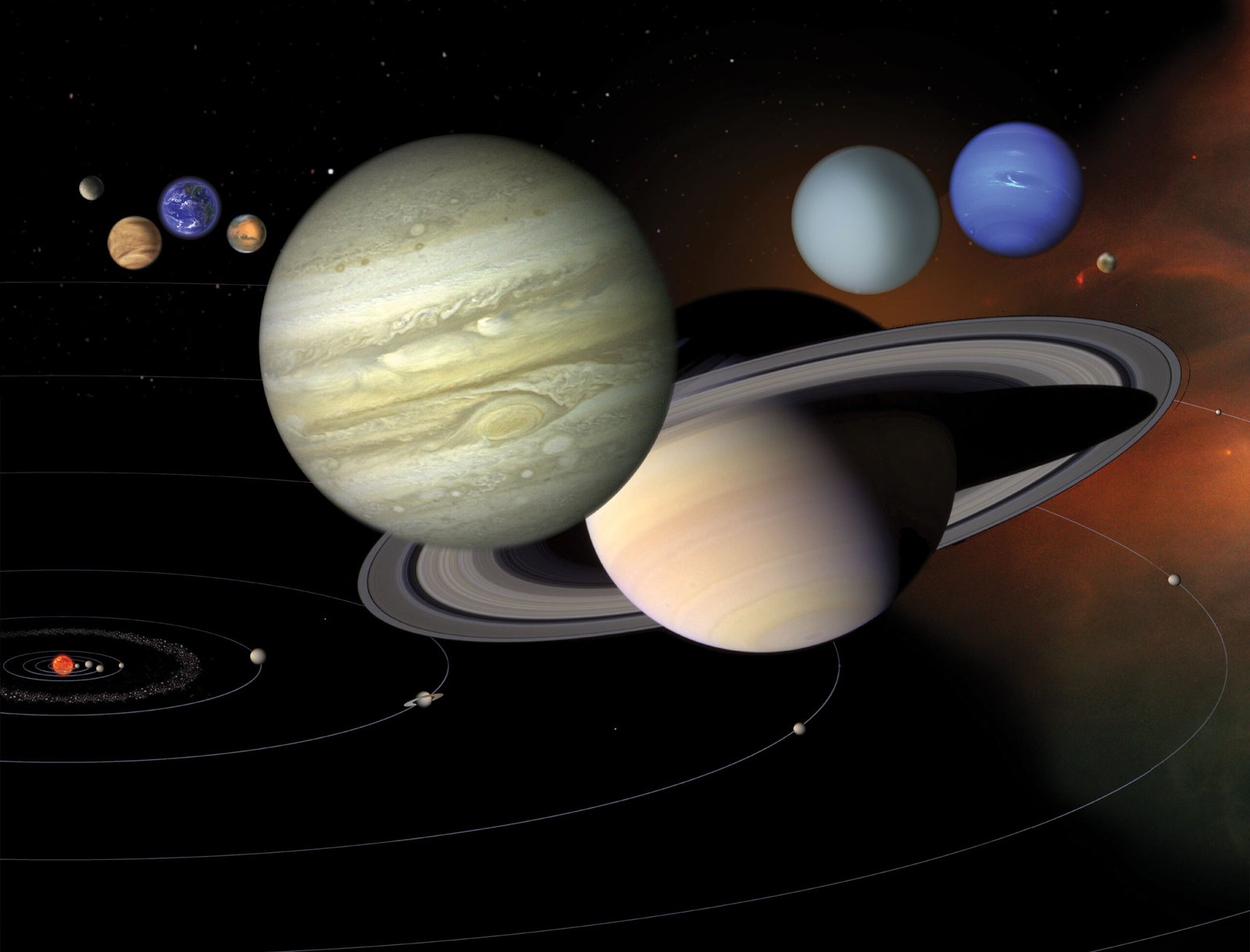
In the Solar System, the International Astronomical Union’s definition describes a planet as a body that orbits the Sun, is nearly round because of its own gravity, and has cleared the neighbourhood around its orbit. A dwarf planet also orbits the Sun and is nearly round, but it has not cleared its orbital neighbourhood and is not a moon.
That definition is a classification rule, not a complete description of a world. Planetary scientists also compare composition, atmosphere, surface processes, magnetic fields, internal heat and geological history. These properties reveal how worlds formed and why they evolved in different ways.
Not every world is a planet. Moons orbit planets or dwarf planets; dwarf planets orbit the Sun; asteroids and comets are smaller bodies with different physical characteristics. Each can still be a complex world worth exploring.
Mercury, Venus, Earth and Mars are the inner terrestrial planets. They have solid surfaces and are made mainly of rock and metal, but their environments differ dramatically. Their contrasts show how distance from the Sun, planetary size, atmosphere, internal activity and geological history shape a world.
A small, rocky world marked by ancient impact craters, cliffs and a large iron-rich core. With almost no atmosphere to redistribute heat, its surface experiences extreme temperature swings.
Venus is similar in size to Earth, but its dense carbon-dioxide atmosphere traps heat with an intense greenhouse effect. Its surface is hot enough to melt lead, beneath clouds of sulphuric acid.
Earth has stable surface liquid water, a nitrogen- and oxygen-rich atmosphere, active plate tectonics and a protective magnetic field. It is the only world where life is confirmed.
Mars preserves evidence of ancient rivers, lakes and possibly long-lived habitable environments. Today it is cold and dry, with a thin atmosphere, polar ice, enormous volcanoes and a landscape shaped by impacts and wind.
Jupiter and Saturn are gas giants, dominated by hydrogen and helium. Uranus and Neptune are ice giants, with interiors thought to contain larger proportions of heavier volatile materials. None has a solid surface like Earth that a spacecraft could land on in the ordinary sense; their visible cloud tops mark the upper atmosphere.
Jupiter is the largest planet. Its deep atmosphere contains powerful jet streams and long-lived storms, including the Great Red Spot. Its moons form a remarkable system of worlds.
Saturn’s rings are broad, bright and complex, made mostly of countless pieces of water ice with rocky material. Its moons include Titan, with lakes of liquid hydrocarbons, and Enceladus, which ejects water-rich plumes.
Uranus rotates with an extreme axial tilt, producing unusual seasonal patterns. Its atmosphere contains hydrogen, helium and methane, while its interior is thought to contain hot, dense fluid rich in water, ammonia and methane.
Neptune is a cold, dynamic ice giant with a deep atmosphere and some of the fastest winds measured on a planet. Its large moon Triton travels in a retrograde orbit and may be a captured object.
Moons are not merely companions in the sky. Some have atmospheres, active volcanoes, underground oceans, weather systems or ancient landscapes. Their environments are shaped by their composition, their distance from the Sun and the gravitational interactions with their parent planets.
A rocky world with ancient impact basins, volcanic plains and permanently shadowed polar craters that contain water ice.
Jupiter’s moon Europa has a fractured icy surface. Evidence points to a global ocean beneath its ice shell, making it a major target in the search for potentially habitable environments.
Saturn’s small moon Enceladus ejects water-rich plumes from fractures near its south pole. Cassini observations revealed a subsurface ocean and chemistry of great interest to astrobiology.
Titan has a thick nitrogen-rich atmosphere and surface rivers, lakes and seas of liquid methane and ethane. Beneath its icy crust, a water-rich interior may include a subsurface ocean.
Europa and Enceladus are especially important in astrobiology because evidence points to subsurface oceans. Titan offers a different kind of environment, with a thick atmosphere and a surface hydrological cycle based on methane and ethane rather than water.
| World type | Typical characteristics | Examples |
|---|---|---|
| Terrestrial planets | Rocky, metal-rich interiors and solid surfaces | Mercury, Venus, Earth, Mars |
| Gas giants | Large hydrogen- and helium-rich planets with deep atmospheres | Jupiter, Saturn |
| Ice giants | Large planets with substantial volatile-rich interiors beneath hydrogen-rich atmospheres | Uranus, Neptune |
| Icy moons | Ice-rich surfaces; some may contain subsurface oceans | Europa, Enceladus, Ganymede |
| Atmospheric moon | Dense atmosphere and surface liquids made of hydrocarbons | Titan |
These categories are useful guides, not perfect boxes. Worlds can have complex mixtures of materials and processes, and new measurements continue to refine our understanding of their interiors.
A planet’s surface is only one part of its story. Heat left from formation, radioactive decay, pressure and chemical differentiation help shape its interior. Dense materials such as iron can sink toward the centre, while lighter materials rise. In some worlds, moving electrically conducting fluids generate magnetic fields.
Atmospheres are equally important. They redistribute heat, create weather, interact with sunlight and radiation, and can protect or transform a surface. Venus’s dense atmosphere drives extreme greenhouse heating; Mars’s thin atmosphere offers little insulation; Earth’s atmosphere supports stable surface liquid water; and the giant planets host deep, dynamic weather systems.
A generic layered rocky-planet model. Actual internal structures vary between worlds and are inferred using multiple measurements.
Earth remains the only place where life is confirmed. But scientists investigate other worlds for environments that could have supported life, either now or in the past. The search focuses on more than a planet’s distance from its star: atmosphere, chemistry, energy sources, liquid solvents and long-term environmental stability all matter.
Potential habitability is not evidence of life. Finding water, organic molecules or a possible energy source does not demonstrate that biology exists. It identifies environments worth investigating with better instruments and future missions.
Scientists combine telescopes with spacecraft observations to understand planets and moons. Each method answers different questions: spectroscopy can reveal atmospheric ingredients; radar can map surfaces through clouds; orbiters measure gravity and magnetic fields; landers and rovers examine local geology; and sample-return missions can bring material to laboratories on Earth.
Robotic missions have visited every planet, and spacecraft have explored many moons and small bodies. Yet most worlds have only been examined from orbit or during brief flybys. Their deep interiors, polar regions, subsurface environments and geological histories still hold unanswered questions.
Explore the broader mission story in Space Exploration & Missions, and the engineering behind these journeys in Rockets & Spacecraft.
How many icy moons contain long-lived oceans, and what do their chemistry and energy sources reveal about possible habitability?
Why did Venus, Earth and Mars develop such different climates, and how do giant-planet atmospheres work at depth?
How are their cores, mantles and oceans structured, and what can gravity and magnetic measurements reveal?
Exoplanet discoveries reveal planetary systems unlike ours. What does that diversity tell us about how planets form and migrate?
There are eight recognised planets: Mercury, Venus, Earth, Mars, Jupiter, Saturn, Uranus and Neptune.
Both orbit the Sun and are nearly round. A planet has cleared its orbital neighbourhood; a dwarf planet has not. A dwarf planet is not a moon.
Mercury, Venus, Earth and Mars are the four terrestrial, or rocky, planets.
Jupiter and Saturn are gas giants. Uranus and Neptune are classified as ice giants.
Saturn’s moon Titan has rivers, lakes and seas of liquid methane and ethane on its surface.
Europa and Enceladus are strong examples. Evidence indicates oceans beneath their icy surfaces, although their habitability and any presence of life remain open questions.
Mars has a harsh surface environment today. Some subsurface settings may be scientifically interesting, but no life has been detected there.
It is possible that some ocean moons offer conditions relevant to life, but there is currently no confirmed evidence of life beyond Earth.
From our planetary neighbourhood to worlds orbiting other stars, follow the connections between planets, stars and the search for life.
For further reading, start with these resources from NASA: