Address
304 North Cardinal St.
Dorchester Center, MA 02124
Work Hours
Monday to Friday: 7AM - 7PM
Weekend: 10AM - 5PM

Address
304 North Cardinal St.
Dorchester Center, MA 02124
Work Hours
Monday to Friday: 7AM - 7PM
Weekend: 10AM - 5PM

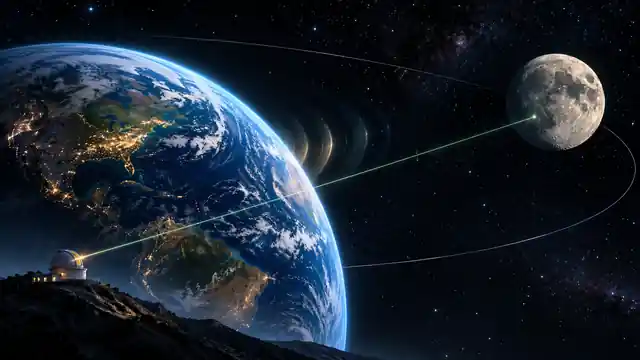
The Moon is drifting away from Earth by about 3.8 centimetres a year. Discover how tides transfer angular momentum, slow Earth's spin and change our sky.
The Moon looks like one of the most dependable things in the night sky. It rises, changes shape through its phases and returns again. But the distance between Earth and its companion is not fixed. The Moon is slowly moving away from us—by about 3.8 centimetres every year.
That is roughly the speed at which fingernails grow. It is far too small to notice from one night to the next. Yet the change is real, measured with laser light and connected to something we experience every day: the tides.
The surprising part is that the Moon is not escaping because Earth’s gravity is weakening. The two worlds are exchanging angular momentum. The oceans rise and fall, Earth rotates, and a tiny gravitational tug transfers part of our planet’s spin into the Moon’s orbit. The result is a wider lunar orbit—and, over time, a slightly slower Earth.
In 1969, Apollo 11 astronauts left more than footprints on the lunar surface. They also placed a panel of small, precisely aligned mirrors called corner-cube retroreflectors. Apollo 14 and Apollo 15 crews left additional arrays. Soviet robotic Lunokhod rovers carried reflectors too.
These devices are still useful. Observatories on Earth send short laser pulses toward the Moon. The mirrors return a small fraction of the light toward its source, and scientists measure how long the round trip takes. Because light travels at a known speed, the travel time reveals the distance.
The round trip takes about 2.5 seconds. With repeated observations and careful analysis, researchers can determine the distance to the reflectors to within a few millimetres. The long record—not one isolated laser pulse—reveals that the average Earth–Moon distance is increasing by about 3.8 centimetres per year. NASA’s Jet Propulsion Laboratory explains how the Apollo experiment continues to return scientific results, while a NASA account of the Lunar Reconnaissance Orbiter reflector test describes the method and its precision.
The average distance between Earth and the Moon is about 385,000 kilometres. The Moon’s orbit is elliptical, so its actual distance changes during each orbit. The 3.8-centimetre figure describes the long-term outward trend, not the much larger monthly variation between its closest and farthest points.
The Moon’s gravity pulls on Earth. It pulls a little more strongly on the side facing the Moon and a little less strongly on the far side. This difference in gravitational pull—called the tidal force—stretches the planet slightly and helps create two broad tidal bulges in an idealised Earth.
Those bulges are the beginning of the explanation, but the important detail is that the real Earth is rotating. Earth completes a spin in about a day, while the Moon takes roughly a month to orbit us. The planet therefore turns beneath the Moon much faster than the Moon travels around Earth.
Water does not instantly rearrange itself into a perfect shape beneath the Moon. Ocean depth, coastlines, seafloor topography and friction all affect how tides move. The tidal response is delayed. In the broad global picture, the tidal bulge is carried slightly ahead of the line connecting Earth and Moon. NASA/JPL describes the highest ocean tide as lying east of the Moon in its explanation of the Earth–Moon interaction.
For a clear introduction to how the Moon and Sun raise tides, see NOAA’s Tides explainer. The real ocean is much more complicated than two neat bulges, but the simplified picture helps reveal the underlying physics.
Imagine the tidal bulge as a small region of extra mass carried slightly ahead of the Moon. The bulge has gravity of its own. Because it is ahead of the Moon, its gravitational pull has a component that tugs the Moon forward along the direction of its orbit.
That forward tug transfers angular momentum from Earth’s rotation to the Moon’s orbital motion. Earth loses a little rotational angular momentum and gradually spins more slowly. The Moon gains orbital angular momentum and settles into a slightly larger orbit. It is not being thrown away; it is moving into a higher orbit while remaining gravitationally bound to Earth.
This is an example of a broader physical principle: angular momentum is conserved in the exchange. The Earth–Moon system does not simply lose the angular momentum that Earth gives up. Some mechanical energy is dissipated as heat through tidal friction, especially in the oceans and the solid Earth, while the Moon’s orbit expands.
A peer-reviewed analysis by James Williams and Dale Boggs, published in Celestial Mechanics and Dynamical Astronomy in 2016, used lunar laser-ranging data and geophysical information about Earth’s tides. It estimated the lunar semimajor axis is increasing by 38.30 ± 0.08 millimetres per year. The same study modelled a long-term increase in Earth’s day length of about 2.395 milliseconds per century from tidal deceleration. You can read the paper’s abstract and results here.
That change is tiny in everyday life. No one will feel a day becoming a fraction of a second longer. But over geological time, even a small persistent effect matters.
Lunar tidal friction is a major long-term influence on Earth’s rotation, but it is not the only one. The atmosphere, oceans, movements in Earth’s interior and changes in the distribution of mass at the surface can all alter the planet’s spin.
In a 19 July 2024 report, NASA’s Jet Propulsion Laboratory described research finding that changes in ice sheets, glaciers and groundwater lengthened Earth’s day by about 1.33 milliseconds per century over the period 2000–2018. That is a different mechanism from lunar tidal friction: when mass moves from the polar regions toward the equatorial oceans, Earth’s shape and moment of inertia change, slowing its rotation in a way similar to an ice skater extending their arms.
The distinction matters. The Moon’s recession is part of a long-term gravitational exchange. Climate-related changes are a separate influence on Earth’s rotation, and their measured contribution depends on the time period being studied. Earth’s day is not controlled by a single clock.
One of the most beautiful consequences of the Moon’s current distance is the total solar eclipse. The Sun is about 400 times wider than the Moon, but it is also about 400 times farther away. From Earth, their apparent sizes are therefore close enough that the Moon can cover the Sun’s bright disk while allowing the solar corona to shine around it.
That alignment is not permanent. As the Moon moves farther away, it appears slightly smaller in our sky. Eventually, even when the Moon is at the closest point in its orbit and the Sun is at its farthest apparent size, the Moon will no longer be large enough to cover the Sun completely.
NASA has described the final total solar eclipse as roughly 600 million years in the future. That is an estimate on an immense timescale, not a countdown that can be predicted to an exact date. The important point is that total solar eclipses are possible because of a particular stage in the Earth–Moon–Sun system’s evolution. We happen to live during it.
For now, the Moon remains close enough to create total eclipses, drive coastal tides and light the night. Its slow recession is far too small to change our experience in a human lifetime. But the same physics that makes the Moon move outward is gradually changing the geometry of our sky.
It is tempting to multiply 3.8 centimetres by a million years and imagine the Moon’s future position. That would be misleading. The current recession rate depends on how energy is dissipated by tides, and tidal dissipation depends on the shape and depth of the oceans, the arrangement of continents and the response of the solid planet.
Earth’s geography has changed dramatically over geological time. Ocean basins have opened and closed; continents have moved; the places where tidal energy is dissipated have changed. The present rate is a measured snapshot of a system whose conditions evolve.
That is why the best scientific answer is not a simple prediction that the Moon will be a certain number of kilometres away after a fixed number of years. It is a description of the physical mechanism, a measurement of its current strength, and an acknowledgement that the system’s future depends on changing conditions.
The Moon is not a distant ornament attached to an otherwise static Earth. It is part of a coupled system. Its gravity raises tides; the tides exert a torque; the torque changes Earth’s rotation and the Moon’s orbit. The evidence is written in the travel time of laser light reflected from small mirrors left by astronauts and robotic explorers more than half a century ago.
In a single year, the change is smaller than the width of a finger. Across centuries, it becomes metres. Across geological time, it changes the rhythm of the planet and the appearance of the sky.
We often think of the heavens as permanent because human lives are brief. The Earth–Moon system reminds us that even the most familiar celestial relationships are evolving. The Moon is still our companion—but the distance between us is slowly changing, and science can measure every quiet centimetre.
Image note: The featured Earth–Moon scene is an original Orbix Universe illustration. The laser beam, orbital spacing and relative presentation are illustrative and not a scale-accurate depiction.

[…] Continue exploring the Solar System Explorer, or read how gravity shapes planetary motion in our guide to Gravity & Relativity. For another example of a changing orbit, see why the Moon is slowly moving away from Earth. […]