Address
304 North Cardinal St.
Dorchester Center, MA 02124
Work Hours
Monday to Friday: 7AM - 7PM
Weekend: 10AM - 5PM

Address
304 North Cardinal St.
Dorchester Center, MA 02124
Work Hours
Monday to Friday: 7AM - 7PM
Weekend: 10AM - 5PM

Explore how space and time fit together, what spacetime means, why time can pass at different rates, and how the expanding universe challenges our understanding of reality.
The Geometry of Space and Time
Understanding the Fabric of the Universe
Space and time are not separate stages for the universe — they are woven together into a single framework called spacetime. It is the framework within which matter, energy and light interact.
Space is the vast, three-dimensional expanse in which everything exists — from atoms and planets to stars and galaxies. It gives objects position, distance and room to move. Although much of space is extremely sparse, it is not simply nothing.
Time is the dimension that lets us describe when events happen, how long they last and the order in which they occur. We measure it with clocks, but time is part of the physical universe, not merely a human invention.
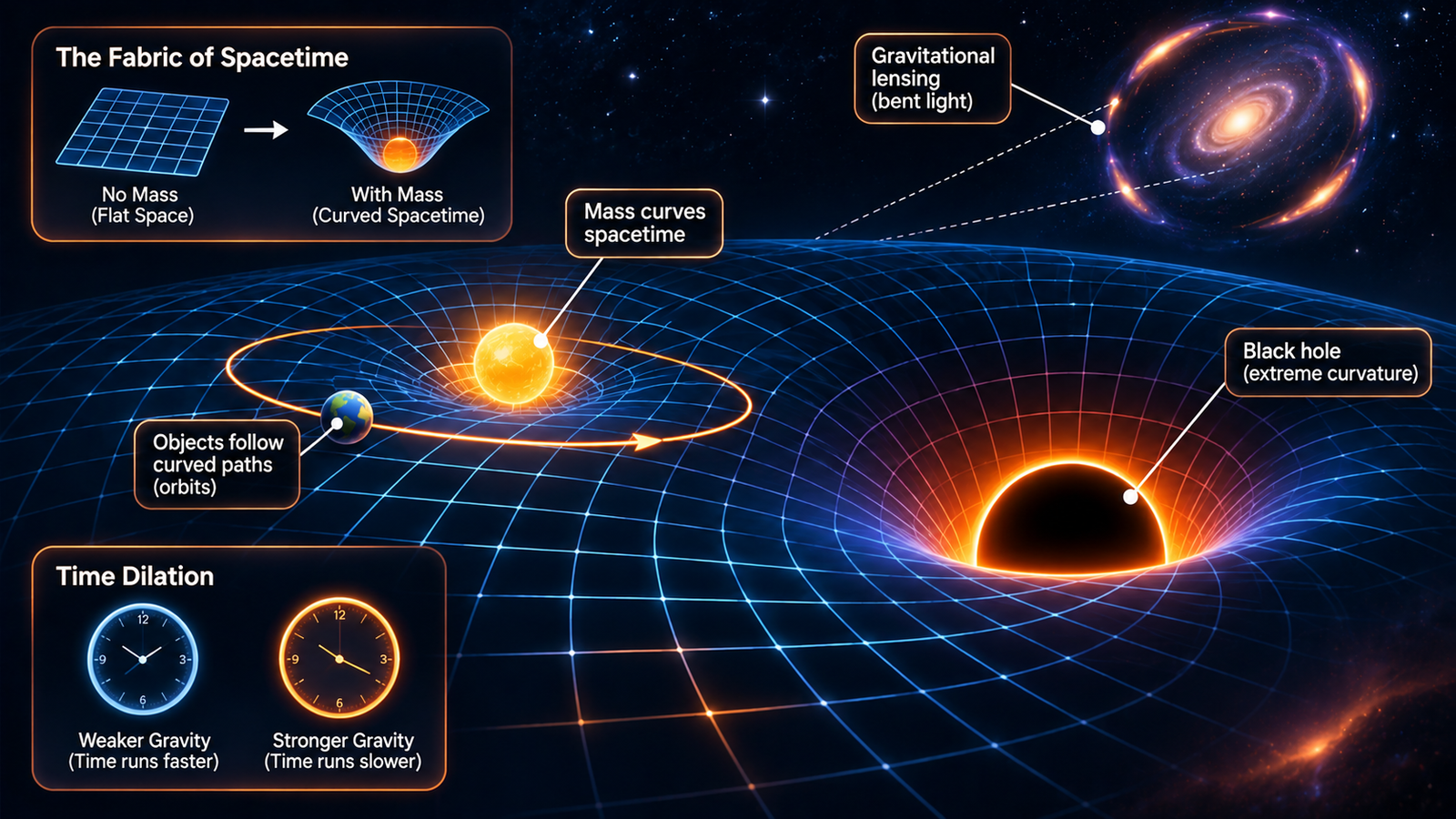
A visual analogy: mass changes spacetime geometry. The grid is not a literal material sheet.
Einstein’s theories of relativity showed that space and time are connected. NASA’s overview of general relativity and spacetime (opens in a new tab) describes spacetime as the four-dimensional framework at the heart of the theory. Each event is described by three spatial coordinates and one time coordinate. An event is located not just by where it happens, but also by when.
Mass and energy influence spacetime geometry. In general relativity, what we experience as gravity is closely connected to that geometry. The familiar image of a heavy object bending a flexible grid is useful, but it is only an analogy for a more complex four-dimensional description.
We experience three spatial dimensions: length, width and height. Time adds a fourth coordinate, allowing physicists to locate events in spacetime. This does not mean time is simply another direction we can turn towards. It has distinct properties and a different role in the laws of physics.
The four-dimensional model is a mathematical framework that helps explain motion, light, gravity and the relationship between observers.
Relativity predicts — and experiments confirm — that elapsed time can differ between observers. NIST’s explanation of testing Einstein’s predictions with atomic clocks (opens in a new tab) describes how precision clocks measure these tiny differences, including the effect of gravity. This effect is called time dilation. Each observer experiences their own clock as normal; differences become apparent when clocks that have followed different paths or experienced different gravitational conditions are compared.
A clock moving relative to an observer is measured to tick more slowly. The effect becomes significant as its speed approaches the speed of light.
Clocks deeper in a gravitational field tick more slowly relative to clocks farther away. This effect has been measured with highly precise clocks.
Satellite navigation systems account for relativistic clock differences to keep positioning accurate.
Yes. On the largest scales, the distances between gravitationally unbound galaxies increase as the universe expands. This is not an explosion from one central point into empty space; rather, the scale of space itself changes over cosmic time.
Bound systems such as atoms, people, planets and the Solar System do not simply stretch with cosmic expansion. Local forces and gravity hold them together.
The scale factor grows; this is a simplified illustration, not a map of galaxy trajectories.
We remember the past, not the future. A dropped glass can shatter, but its pieces do not spontaneously reassemble. This everyday direction is linked to the second law of thermodynamics: in an isolated system, entropy tends not to decrease.
Entropy is often described as disorder, but more precisely it relates to the number of microscopic arrangements compatible with a system’s overall state. The universe’s early low-entropy condition and the origin of time’s arrow remain active areas of research.
Relativity has passed many demanding tests, but it is not a complete description of every physical situation. General relativity describes gravity on large scales; quantum theory describes matter and interactions at very small scales. Bringing these frameworks together remains a major challenge.
Scientists investigate spacetime through observation and experiment. They compare precise clocks, track planetary motion, observe light bending around massive objects, measure distant galaxy redshifts and detect gravitational waves.
Space and time are not merely the backdrop to cosmic events. Their properties influence how light travels, how planets orbit, how stars evolve and how the universe changes. Understanding them gives us a foundation for almost every other subject in astronomy and physics.
When you look at a distant star, you see light that began its journey in the past. Looking farther into space lets us observe earlier chapters of cosmic history.
The farther we look into space, the deeper we look into the history of the universe.
No. They have different physical properties, but relativity shows that they are linked and must be described together as spacetime.
In standard relativity, spacetime has four dimensions: three spatial dimensions and one time dimension.
Yes. Time dilation is a measured physical effect. Relative motion and differences in gravitational potential can cause clocks to accumulate different amounts of elapsed time.
The observable universe has a horizon beyond which signals have not had time to reach us. That horizon is not a known physical edge of the entire universe.
No. Space contains matter, radiation, particles and fields, although many regions are far less dense than anything we encounter on Earth.
Light takes time to travel. The farther away an object is, the longer its light may have been travelling before it reaches us, so we observe it as it was when that light began its journey.
This page is part of The Cosmic Blueprint, our guide to the physical principles that shape the universe. Continue exploring through these connected topics: