Address
304 North Cardinal St.
Dorchester Center, MA 02124
Work Hours
Monday to Friday: 7AM - 7PM
Weekend: 10AM - 5PM

Address
304 North Cardinal St.
Dorchester Center, MA 02124
Work Hours
Monday to Friday: 7AM - 7PM
Weekend: 10AM - 5PM

Discover how humans live beyond Earth: microgravity, radiation, life-support systems, food, exercise, sleep, mental health, space stations and the challenges of building habitats on the Moon and Mars.
Imagine waking up without a floor beneath your feet. Your water floats in droplets, your muscles no longer work against your full body weight, and the horizon outside your window curves around an entire planet. In orbit, even the ordinary routines of life—sleeping, eating, washing and staying healthy—become engineering challenges.
Human beings evolved on Earth. Our bodies depend on gravity, a protective atmosphere, liquid water, a stable temperature range and a complex living environment. Space provides none of these automatically. To live beyond Earth, we must carry a small, carefully controlled version of our planet with us—and learn how to live inside it.
Living in space means maintaining a safe and workable human environment inside a spacecraft, orbital station or future surface habitat. It is not just about keeping astronauts breathing. A long-duration habitat must provide breathable air, suitable pressure, clean water, food, waste management, temperature control, power, medical support, communication and protection from hazards.
It must also support human behaviour. People need sleep, privacy, exercise, meaningful work, recreation, social connection and a sense of time. A habitat can be technically functional and still be a difficult place to live if it ignores the psychological and social needs of its crew.
People often say astronauts experience zero gravity, but that is not quite right. The International Space Station and other orbiting spacecraft are still strongly affected by Earth’s gravity. They and their crews are in continuous free fall around the planet. Because the spacecraft and everything inside it fall together, astronauts experience apparent weightlessness, commonly called microgravity.
This changes almost every physical task. Objects do not rest on surfaces unless restrained. Fluids form floating blobs. Flames behave differently. The human body no longer needs to support its weight in the familiar way, and that has consequences over time.
Muscles used to maintain posture and move against gravity can weaken when they are unloaded. Astronauts follow structured resistance and aerobic exercise programmes to limit loss of strength and endurance.
Weight-bearing bones can lose mineral density in microgravity. Exercise helps, but it does not remove every risk. Bone health is monitored before, during and after missions.
Without gravity pulling fluids toward the lower body, fluids shift toward the head. This can cause facial puffiness, nasal congestion and changes in fluid distribution, including effects on vision in some astronauts.
The inner ear and brain receive unfamiliar signals. Some astronauts experience space motion sickness while adapting. After returning to Earth, balance and coordination may take time to readjust.
Microgravity also changes how the cardiovascular system works. The heart and blood vessels adapt to a different fluid distribution and workload. On return to gravity, some astronauts experience dizziness or difficulty tolerating standing until their bodies readjust.
Earth’s atmosphere and magnetic field provide important protection from space radiation. In orbit, astronauts are exposed to energetic particles from the Sun and galactic cosmic rays. The amount of exposure depends on altitude, orbital inclination, solar activity, shielding and mission duration.
Radiation can damage cells and DNA, increasing long-term health risks. A major solar particle event can also create an acute hazard, particularly outside Earth’s protective magnetic environment. Spacecraft design therefore considers shielding, monitoring, storm shelters and operational procedures for periods of elevated solar activity.
On missions beyond low Earth orbit, radiation protection becomes more difficult. Engineers may use shielding from water, supplies or specialised materials, but shielding against high-energy cosmic rays is a complex problem: some particles can generate secondary radiation when they strike shielding. There is no simple wall that makes deep space radiation disappear.
A space habitat must keep its internal environment within safe limits. The collection of equipment that performs these tasks is called an Environmental Control and Life Support System (ECLSS). Its exact design varies by spacecraft and mission, but the essential functions are broadly similar.
The cabin must maintain suitable pressure and oxygen partial pressure. Systems may store oxygen, generate it from water by electrolysis, or use a combination of supplies and recovery equipment.
People exhale carbon dioxide. Scrubbers remove it from cabin air so concentrations do not rise to unsafe levels. Different systems use replaceable cartridges, regenerable materials or other chemical and mechanical processes.
Water is heavy and expensive to launch. Orbital systems can recover water from humidity condensate and, in some systems, urine. Recovered water is processed and monitored before reuse.
Equipment, people and sunlight create heat. Fans, heat exchangers, coolant loops and radiators move heat away and keep cabin conditions comfortable. Humidity control also protects equipment and crew health.
Waste collection must work without gravity. Toilets use airflow and specialised collection systems to manage liquids and solids hygienically and prevent contamination.
Fire, smoke, toxic leaks and pressure loss are serious emergencies in a sealed habitat. Detection, isolation, suppression equipment, protective masks and crew procedures are essential.
Space food must be safe, nutritious, stable for the mission duration and practical to prepare and eat. Many foods are packaged, rehydratable or thermostabilised. Crumbs and loose liquids are more than a housekeeping problem: they can enter ventilation systems or sensitive equipment. Drinks are contained in sealed pouches, and utensils and food packaging are designed for microgravity.
Fresh food is difficult to supply regularly, although small plant-growth experiments have demonstrated that crops can be cultivated in space. Growing food could eventually supplement diets on long missions, but it requires light, water, nutrients, controlled airflow, space and reliable equipment. It is not yet a replacement for a complete food supply.
Water is carefully managed for drinking, food preparation, hygiene and technical systems. Even when water is recycled, crews need monitoring and treatment systems to maintain quality. A leak, contamination event or equipment failure can quickly become a mission-level problem.
On an orbital station, crew schedules coordinate experiments, maintenance, exercise, communications, meals, personal time and sleep. The station can experience many sunrises and sunsets in a single Earth day, so an agreed schedule and lighting help maintain a stable routine. Workloads are planned to reduce fatigue and protect time for rest.
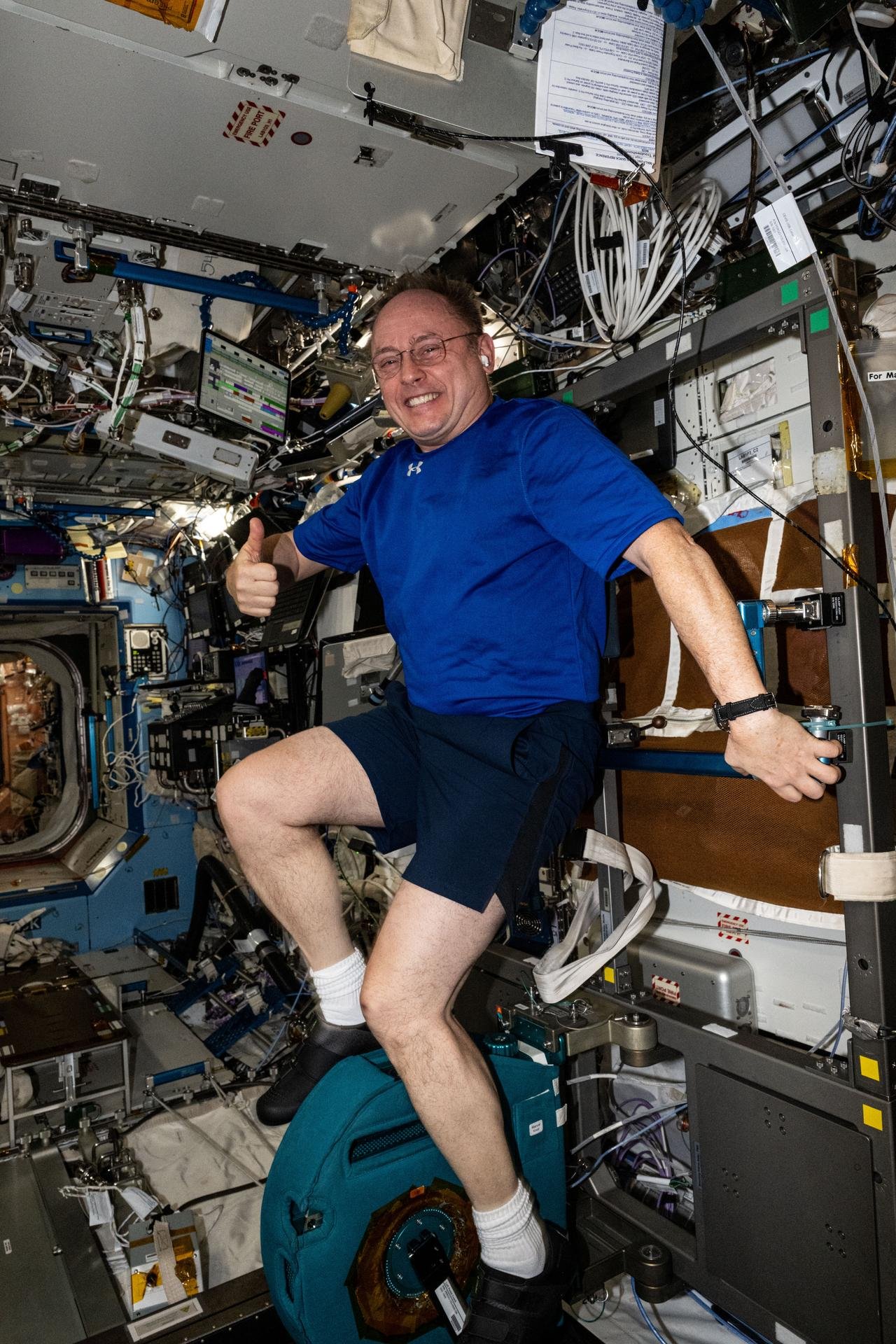
Exercise equipment in space must work without a stable floor or body weight. Space stations use specialised devices such as treadmills with harnesses, cycle ergometers and resistance machines. Astronauts typically spend a substantial part of each day exercising to reduce the loss of muscle, bone and cardiovascular fitness.
Exercise is only one part of countermeasure planning. Nutrition, medical monitoring, workload management and rehabilitation after landing also matter. The goal is not simply to complete a mission, but to return with the ability to function safely on Earth—or to continue working in a different gravity environment.
Space habitats are compact, noisy workplaces shared by a small crew. There may be little privacy, limited personal space and a demanding schedule. Communication delays, separation from family, confinement and the knowledge that help is far away can add psychological stress.
Crew members use scheduled sleep periods, individual sleeping areas, exercise, recreation, private communication with family and regular contact with mission support teams. Lighting can help maintain circadian rhythms. Team selection and training also consider communication, conflict management, cultural awareness and the ability to work under pressure.
For a Mars mission, the psychological environment becomes more challenging. Communication delays mean conversations with Earth cannot happen in real time, and an emergency cannot be solved by a quick return. Crews will need greater autonomy and robust ways to manage stress and disagreement.
A spacewalk, or extravehicular activity (EVA), takes an astronaut outside a pressurised spacecraft or station. The spacesuit is effectively a miniature spacecraft: it supplies oxygen, removes carbon dioxide, controls temperature, maintains pressure, provides communications and protects against parts of the space environment.
Spacewalks support construction, repairs, inspections and scientific work. They are physically demanding and require extensive preparation. A suit leak, cooling problem, tether failure or loss of communication can become life-threatening. Crews train for planned tasks and emergency procedures in specialised facilities before flight.
Human spaceflight is shaped by different national programmes, station architectures and international partnerships. The following examples show distinct approaches. They should not be read as a simple ranking: each programme has different objectives, operating histories and levels of maturity.
The International Space Station (ISS) is a multinational orbital laboratory involving the United States, Russia, Japan, Canada and participating European countries through their space agencies. It supports long-duration research in human physiology, biology, materials, fluid physics, technology and Earth observation. Its modules, robotics, visiting vehicles and operational systems reflect decades of cooperation and engineering.
The ISS is not owned by one country. NASA, Roscosmos, ESA, JAXA and the Canadian Space Agency each contribute to its operation and use. Astronauts from many nations have lived and worked aboard it. The station also illustrates how international cooperation can make a complex human-spaceflight project possible.
Reference: NASA — International Space Station.
Russia’s human-spaceflight experience includes the Salyut stations, the long-running Mir station and its continuing participation in the ISS programme. Soyuz spacecraft have been a central crew transportation system, while Progress vehicles deliver cargo and supplies. Russian modules and systems remain part of the ISS architecture, and Russian cosmonauts contribute to station maintenance, experiments and spacewalks.
Russia’s history is important to the development of long-duration space habitation, including lessons from Mir and the operational experience accumulated through decades of orbital missions. Present-day operations should be distinguished from proposed future station plans, which are subject to change.
Reference: Roscosmos.
China operates Tiangong, a modular space station in low Earth orbit. Crews arrive aboard Shenzhou spacecraft and cargo is delivered by Tianzhou vehicles. The station supports crewed stays, scientific experiments, technology demonstrations and operational experience in maintaining an independent orbital outpost.
Tiangong is a separate station from the ISS and is operated by China’s human-spaceflight programme. Its existence means long-duration human activity in orbit is no longer limited to the ISS partnership. China’s future plans may expand its capabilities, but proposed missions and infrastructure should not be described as completed until they are operational.
Reference: China Manned Space Agency.
India is developing Gaganyaan, its first independent human-spaceflight programme. The mission is designed to carry a crew to low Earth orbit aboard a human-rated LVM3 and return them safely to Earth. Its systems include a Crew Module, Service Module, Crew Escape System and Environmental Control and Life Support System.
As reported by India’s Department of Space to Parliament on 6 August 2026, the first uncrewed experimental Gaganyaan mission carrying the Vyommitra half-humanoid was targeted for the fourth quarter of 2026. Two further uncrewed missions in the crewed-flight configuration were planned before the first crewed orbital mission, targeted by 2027. The same update reported successful completion of the TV-D1 crew-escape test and two Integrated Air Drop Tests, while work on TV-D2 and further ground qualification continued. These are programme targets and reported test milestones, not evidence that India has already completed a crewed Gaganyaan flight.
India’s longer-term plan includes the Bharatiya Antariksh Station, intended to be operational by 2035. The government has approved development of its first module, BAS-01, and ISRO has described a five-module station configuration. It remains a project under development, not an operational habitat. Its eventual realisation will require crew transportation, life support, docking, station modules, logistics and long-duration human operations.
Reference: Department of Space — Gaganyaan and India’s human-space-exploration roadmap, 6 August 2026.
References: ISRO Human Space Flight Centre — Gaganyaan · ISRO — Gaganyaan FAQ.
An orbital station travels around Earth and can receive supplies from the planet below. A lunar or Martian habitat faces a harsher environment and more difficult logistics. The Moon has no substantial atmosphere, extreme temperature variation, abrasive dust and radiation exposure. Mars has a thin carbon-dioxide atmosphere, cold conditions, dust storms, radiation hazards and lower gravity than Earth.
Habitats must protect crews from vacuum, radiation, micrometeoroids, temperature extremes and lunar dust. Local resources such as polar water ice may eventually support life-support systems or propellant production, but extraction at useful scale remains a major engineering challenge.
A crewed mission would require months of transit, long periods on the surface and a return strategy. Habitats need radiation protection, reliable power, food, water, oxygen production, maintenance capability and robust medical support with limited real-time help from Earth.
Both destinations raise a fundamental question: how much can a settlement rely on supplies from Earth, and how much must it produce locally? The more self-sufficient a habitat becomes, the more complex its machinery, maintenance and resource systems become.
Long-term settlement raises questions that current human spaceflight has not answered. We do not yet understand the full effects of partial gravity, radiation and the space environment on reproduction, pregnancy, fetal development, childhood growth and multiple generations. It would be irresponsible to assume that human reproduction in space is safe or straightforward.
Permanent communities would also need more than habitats and transport. They would require medical care, education, governance, food production, manufacturing, social institutions, cultural life and reliable access to resources. A continuously occupied outpost is not automatically a self-sustaining civilisation.
These are open research and policy questions, not solved capabilities. They belong at the intersection of space medicine, biology, engineering, ethics and social science.
Future habitats may use inflatable or modular structures, improved radiation protection, more efficient water and air recycling, advanced plant-growth systems and autonomous maintenance. Commercial stations may provide new destinations in low Earth orbit as the ISS era eventually changes. Lunar surface habitats could test technologies needed for longer missions, while Mars remains a much more demanding goal.
The key advances may not be spectacular rockets. They may be quiet systems that make air safer, recycle more water, detect failures earlier, protect bone and muscle, grow fresh food and keep a crew psychologically healthy. A sustainable human presence in space depends on making ordinary life reliably possible in an extraordinary environment.
Not in the vacuum outside a spacecraft. Humans need a pressurised, temperature-controlled environment with breathable air. Inside a properly functioning habitat, astronauts can wear ordinary clothing; outside it, they need a spacesuit.
They are in continuous free fall along with their spacecraft. Earth’s gravity is still acting on them, but the shared fall produces apparent weightlessness, or microgravity.
Microgravity can cause muscle and bone loss, fluid shifts and cardiovascular changes. Radiation adds health risks, and isolation and disrupted sleep can affect wellbeing. Exercise, monitoring and other countermeasures reduce but do not eliminate these risks.
Life-support systems maintain cabin pressure and oxygen levels, remove carbon dioxide and monitor air quality. Oxygen can be supplied from stored reserves or generated by systems such as water electrolysis, depending on the spacecraft.
Some orbital life-support systems recover water from urine and cabin humidity condensate, then process and monitor it to meet water-quality requirements. Recycling is a major way to reduce resupply needs.
They use sleeping bags or personal sleep stations secured to a wall or other surface so they do not drift around. A planned schedule and controlled lighting help maintain sleep routines.
India is developing the Gaganyaan human-spaceflight programme and the systems required to carry a crew to orbit and return them safely. Development and test milestones should not be confused with a completed crewed orbital mission.
No operational Indian space station exists at present. The Bharatiya Antariksh Station is a planned future project, while Gaganyaan is the programme developing India’s initial human-spaceflight capability.
Not yet. A permanent settlement would require reliable life support, radiation protection, food and water production, power, medical care, maintenance, transport and solutions to major biological and social uncertainties.
Living in space depends on the vehicles, technologies and missions that make human spaceflight possible. Explore the engineering behind them and the larger future of a spacefaring civilisation.