Address
304 North Cardinal St.
Dorchester Center, MA 02124
Work Hours
Monday to Friday: 7AM - 7PM
Weekend: 10AM - 5PM

Address
304 North Cardinal St.
Dorchester Center, MA 02124
Work Hours
Monday to Friday: 7AM - 7PM
Weekend: 10AM - 5PM

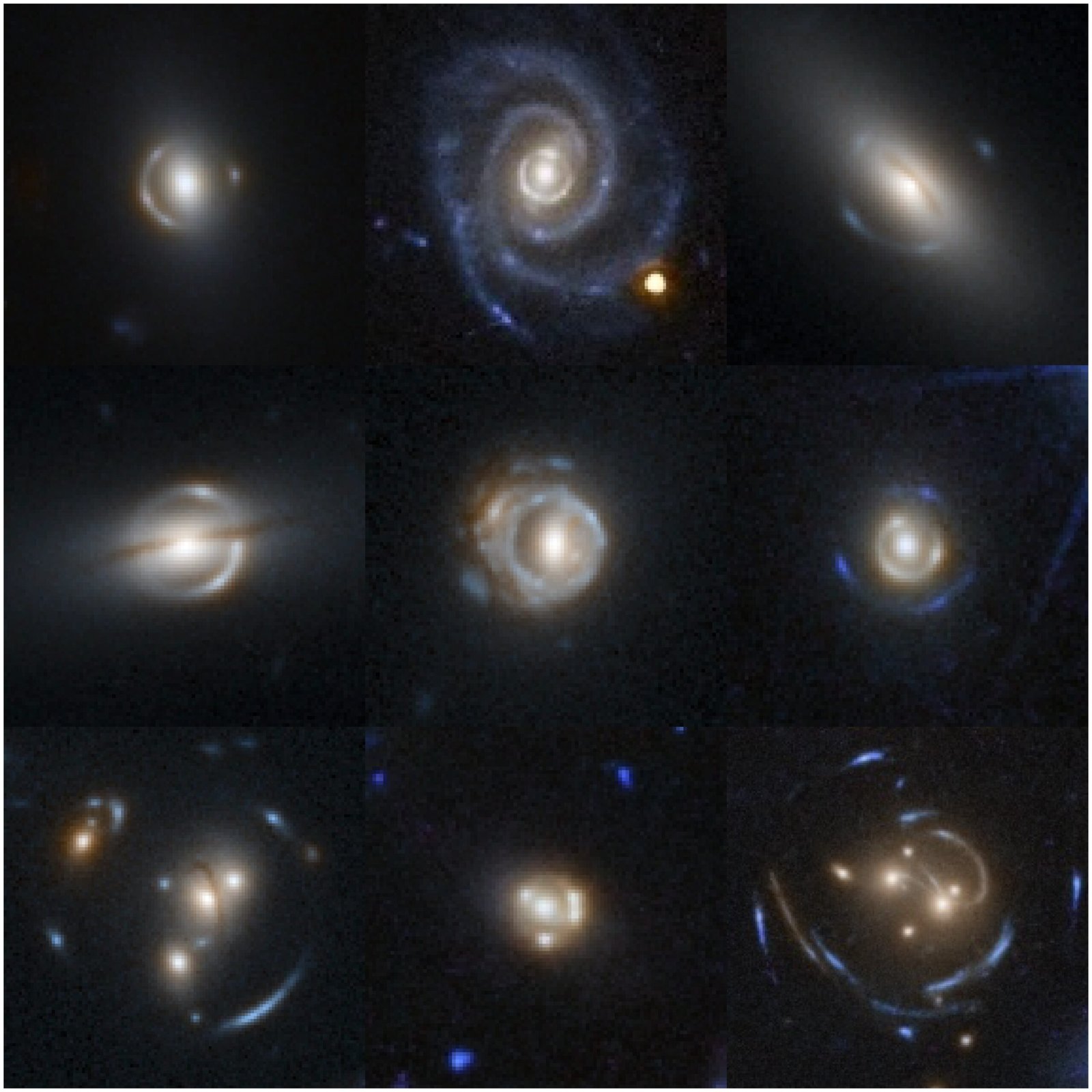
ESA’s Euclid telescope has released its first major data batch: more than 900 million galaxies and 15,072 high-confidence strong-lens candidates. Here is how gravity helps map the dark Universe—and what the data do not yet prove.
Imagine trying to draw a map of a city when most of its streets are invisible. You cannot see the roads directly, but you can watch how traffic bends, slows and changes direction. From those movements, you can begin to reconstruct the hidden layout.
That is, in a much grander and stranger way, what astronomers are attempting with the Universe. On 12 November 2026, the European Space Agency and the Euclid Consortium released the first major batch of data from the Euclid space telescope. It contains more than 900 million catalogued galaxies, over 60 million quasar candidates and spectra for more than 160 million sources. Hidden among that enormous collection is a catalogue of 15,072 high-confidence candidates for one of gravity’s most spectacular effects: strong gravitational lensing.
The result is not a photograph of the entire Universe, nor a discovery of dark matter itself. It is something more useful: a new observational foundation for studying how galaxies, mass and cosmic structure are arranged across time.
The new dataset is called DR1-Foundation. It is the first part of Euclid Data Release 1, built from roughly 13 months of observations gathered between spring 2024 and spring 2025. The validated wide-survey portion covers about 1,900 square degrees of sky—an area equivalent to roughly 9,500 full Moons as seen from Earth. That is about 14% of the area planned for Euclid’s six-year survey.
The scale is difficult to picture, so consider what the release contains:
| What was released | Approximate amount |
|---|---|
| Catalogued galaxies | More than 900 million |
| Quasar candidates | More than 60 million |
| Spectra from sources | More than 160 million |
| Strong gravitational-lens candidates | 15,072 high-confidence, plus 9,010 possible candidates |
| Data volume | About 1.7 petabytes |
The Euclid Consortium says the release includes around 10,000 science images from the telescope’s two instruments, alongside catalogues and spectra. The data are not simply a collection of beautiful pictures. They are measurements that researchers can use to estimate distances, compare galaxy populations, study gravitational effects and reconstruct the large-scale structure of the cosmos.
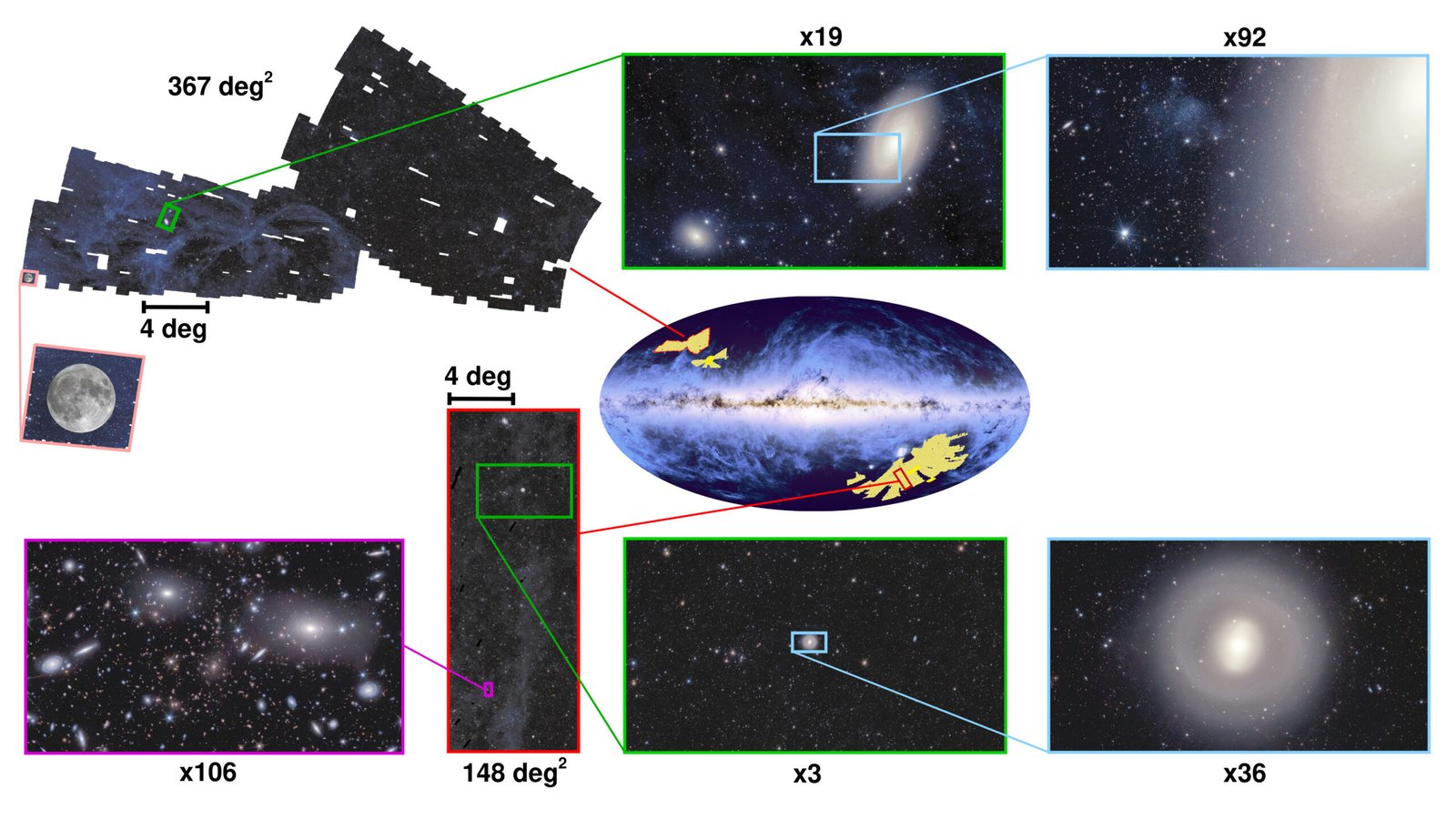
One distinction matters: the more than 60 million quasars are candidates, not all individually confirmed quasars. And the 900 million galaxy count does not mean every galaxy has a precise spectroscopic distance. Euclid has spectra for a substantial subset—more than 160 million sources—while the wider catalogue provides other kinds of measurements.
The most visually striking part of the release may be the catalogue of strong gravitational lenses. To understand why it matters, imagine two galaxies almost lined up from our point of view. The more distant galaxy sends light towards Earth. Before that light reaches us, it passes close to a massive foreground galaxy.
According to Einstein’s general theory of relativity, mass curves spacetime. Light follows that curved geometry. The foreground galaxy therefore bends the path of the background galaxy’s light. Depending on the alignment and the distribution of mass, the distant galaxy can appear as a stretched arc, several separate images, or a nearly complete ring known as an Einstein ring.
The foreground galaxy acts like a natural telescope. It can magnify a background object that would otherwise be too faint or too small for us to study in detail. But the lens does more than make distant galaxies easier to see. The shape of the distortion contains information about the mass doing the bending.
That mass includes the stars and gas we can see, but it can also include dark matter. By modelling the lensing pattern, astronomers can infer how much mass is present and how it is distributed. Strong lensing is therefore one of the few ways to weigh individual galaxies, including their invisible matter.
For a wider introduction to the invisible mass shaping galaxies, explore Orbix Universe’s guide to dark matter and dark energy, and our explanation of gravity and relativity.
The Euclid Collaboration’s ECLIPSE catalogue paper reports 15,072 high-confidence strong-lens candidates. They are divided into 6,073 grade A systems, described as “sure lens” candidates, and 8,999 grade B systems, described as “probable lens” candidates. The researchers also list a further 9,010 grade C systems as possible candidates.
Those labels are important. A candidate catalogue is not the same as a list of individually confirmed objects. The grades reflect the strength of the evidence and the classification process. The distinction allows researchers to use the most secure sample while retaining less certain systems for further investigation.
Even with that caution, the scale is remarkable. Strong lenses are rare: ESA notes that only about one galaxy in several thousand acts as a strong lens. Before Euclid, astronomers had assembled far smaller catalogues, making it difficult to study lenses as a population rather than as isolated curiosities. The new high-confidence sample is larger than all previous catalogues combined, giving researchers a much more uniform population to compare.
The catalogue includes unusual configurations as well as familiar rings. Some systems show multiple background galaxies at different distances being lensed by the same foreground object. Others involve spiral galaxies or lensed quasars. Such systems are valuable because their geometry can reveal details about the foreground galaxy’s mass and, in some cases, magnify distant galaxies that would otherwise remain difficult to observe.
Finding a few thousand rare lenses inside hundreds of millions of astronomical sources is a search problem on an extraordinary scale. The Euclid team did not rely on a single algorithm or ask artificial intelligence to make the final decision alone.
The ECLIPSE discovery pipeline began with a catalogue-level selection that narrowed roughly 900 million sources to about 68 million objects for closer examination. Five machine-learning models helped rank and identify promising candidates. The search then combined automated results with citizen-science classifications and expert review.
Around 7,000 volunteers contributed visual classifications. The collaboration papers describe more than 4.5 million volunteer classifications of 300,000 objects, followed by inspection of more than 30,000 objects by 67 strong-lensing experts. The process is a useful example of how machines and people can complement one another: algorithms can scan enormous datasets quickly, while human observers can recognise unusual structures and experts can judge ambiguous cases.
That collaboration is part of the scientific result. The catalogue is not merely a collection of computer-generated flags; it is the outcome of a documented search and grading process designed to make rare gravitational patterns usable for research.
Euclid launched on 1 July 2023 and operates around the Sun–Earth L2 point, about 1.5 million kilometres from Earth. Its 1.2-metre telescope feeds light to two instruments that work in different parts of the spectrum.
Redshift is one of the key tools for turning a flat image of the sky into a three-dimensional map. As the Universe expands, light travelling across it is stretched to longer wavelengths. By measuring that shift, astronomers can estimate how far away a galaxy is and how far back in cosmic time they are seeing it.
Combine those distances with the positions and shapes of galaxies, and the distribution of matter begins to emerge. The aim is to trace the cosmic web—the vast network of filaments, clusters and voids that gives the Universe its large-scale structure. You can explore the broader story of galaxies and cosmic structures and phenomena in our existing guides.
Dark matter does not shine like stars, but it contributes gravity. When light from a distant galaxy passes through a region containing dark matter, its path can be bent. Strong lensing makes some of those effects visually obvious. Weak lensing is subtler: it slightly stretches the apparent shapes of many background galaxies, so astronomers need to measure enormous samples and look for statistical patterns.
Euclid is designed to use both approaches, alongside galaxy clustering and distance measurements, to investigate how matter is distributed and how cosmic structure has grown. The same large-scale map can help researchers test models of dark energy, the name given to whatever is driving the accelerated expansion of the Universe.
But this first data release has not identified a dark-matter particle, nor has it settled what dark energy is. The lens catalogue provides a powerful new way to study mass in galaxies. The full cosmological analyses require additional measurements and careful control of systematic effects.
That is why the name DR1-Foundation matters. The Euclid Collaboration’s data-release overview says the remaining part of DR1 is expected in June 2027. It is planned to add shear measurements and Level 3 products needed for cosmological analyses. In other words, the foundation is now available; some of the most important tests are still ahead.
Euclid’s new release is both enormous and incomplete. It contains more than 900 million galaxies, but it covers only about 14% of the area planned for the mission’s six-year survey. It includes a record-setting catalogue of strong-lens candidates, but those candidates still need to be studied, modelled and interpreted. It offers clues about dark matter and the history of cosmic expansion, but it is not a final answer to either mystery.
That is what makes the release significant. Science advances not only when an observation solves a problem, but when it gives researchers a new scale of evidence with which to ask better questions. Euclid has turned rare gravitational distortions into a population that can be examined statistically—and made a vast amount of sky available for independent investigation.
For the first time, thousands of cosmic magnifying glasses are being studied together, while hundreds of millions of other galaxies provide the wider context. The invisible Universe has not suddenly become visible. But its gravitational handwriting is becoming easier to read.
