Address
304 North Cardinal St.
Dorchester Center, MA 02124
Work Hours
Monday to Friday: 7AM - 7PM
Weekend: 10AM - 5PM

Address
304 North Cardinal St.
Dorchester Center, MA 02124
Work Hours
Monday to Friday: 7AM - 7PM
Weekend: 10AM - 5PM

Explore the types, structure and evolution of galaxies—from spiral and elliptical systems to dwarf galaxies, galactic collisions, supermassive black holes and the cosmic web.
The night sky shows us individual stars, but stars are only part of a much larger story. Across the universe, gravity gathers stars, gas, dust and dark matter into immense systems called galaxies. Some form graceful spiral patterns; others are smooth and elliptical, or irregular and disturbed. Galaxies grow, interact and change over billions of years—and their stories help us understand how the universe is organised.
A stylised spiral galaxy. The visible arms contain stars, gas and dust, while much of a galaxy’s mass is not visible directly.
A galaxy is a gravitationally bound system containing stars, stellar remnants, gas, dust and dark matter. Galaxies range from small dwarf systems containing relatively few stars to enormous galaxies with hundreds of billions or even more. Their contents move within a shared gravitational environment, although the details of their structure and histories differ widely.
Galaxies are not sealed islands. They exchange gas with their surroundings, interact with neighbours and can merge. Their evolution is shaped by gravity, the supply and cooling of gas, star formation, stellar feedback and the growth of central black holes.
A galaxy is more than the stars we see. The stars and glowing gas reveal only part of its contents. Dark matter is inferred from its gravitational influence on visible matter, motions and light.
Astronomers classify galaxies by their visible shapes and structural features. These categories help organise observations, but they do not tell the whole story: galaxies can change shape, and their appearance depends on viewing angle, wavelength and evolutionary history.
Spiral galaxies have flattened rotating discs, central bulges and spiral arms. The arms often contain gas, dust and active star-forming regions.
Elliptical galaxies range from nearly spherical to elongated. They are dominated by older stars and often contain relatively little cold gas for new star formation, though their histories vary.
Lenticular galaxies combine a central bulge and disc with no obvious spiral arms. They are often classified between spiral and elliptical forms, though their origins can be varied.
Irregular galaxies lack the well-defined structure of spirals and ellipticals. Interactions, gravitational disturbances and internal processes can contribute to their varied shapes.
Dwarf galaxies are much smaller and less massive than large galaxies. They are common in the universe and often orbit larger galaxies, sometimes being stretched or disrupted by gravity.
In star-forming galaxies, gas clouds collapse to form new stars. Bright regions of ionised gas can mark the locations of recently formed massive stars.
Galaxies are not distributed randomly. They gather into groups and clusters, linked by gravity and embedded in larger dark-matter structures.
When galaxies pass close to one another, gravity can distort their shapes, trigger bursts of star formation and eventually bring them together. Individual stars usually remain far apart during these encounters.
Many large galaxies host supermassive black holes at their centres. When gas falls toward a black hole, the surrounding accretion flow can become extremely luminous and power an active galactic nucleus.
Spiral and elliptical galaxies are familiar broad categories, but the real population is diverse. Lenticular galaxies have disc-like structures without obvious spiral arms; dwarf galaxies come in several forms; and irregular galaxies can show signs of gravitational disturbance or vigorous star formation.
Spiral galaxies provide a useful way to explore the different components that can make up a large galaxy. Not every galaxy has all of these features, and their relative importance varies.
Simplified side-on and structural schematic. Real galaxies are three-dimensional, and not all have the same components or proportions.
Galaxies grew from small density variations in the early universe. Under gravity, matter gathered into increasingly large structures. Dark matter helped form gravitational wells, while ordinary gas fell into them, cooled and eventually formed stars. Over cosmic time, galaxies grew through continued gas accretion, star formation and mergers with other systems.
This process is not identical for every galaxy. Some galaxies build stars steadily over long periods; others experience intense bursts of star formation. Some become relatively quiet after their supply of cold gas is reduced or heated, while interactions can reshape their structure and change how quickly they form stars.
Galaxies can gain gas from their surroundings. When that gas cools and becomes dense enough, it can contribute to new star formation.
Cold gas clouds collapse to form stars. Massive young stars then return energy and material to their surroundings, influencing later star formation.
Close encounters can distort galaxies, drive gas inward and sometimes trigger bursts of star formation. Mergers can build larger systems.
Energy from young stars and active galactic nuclei can heat or expel gas, changing a galaxy’s ability to form stars.
Galaxies move under gravity, and their paths can bring them into close encounters. A collision between galaxies is not like two solid objects crashing together: the distances between individual stars are enormous, so direct star-to-star collisions are rare. Instead, gravity reshapes the galaxies, disturbs their gas and changes their orbits.
Over time, two galaxies can merge into one larger system. Their gas clouds may collide and compress, sometimes producing a burst of star formation. Tidal forces can pull out long streams and tails of stars and gas. The final galaxy’s shape depends on the masses, gas content, orbital geometry and other details of the encounter.
Conceptual sequence of a galactic interaction. The real process can take hundreds of millions or billions of years.
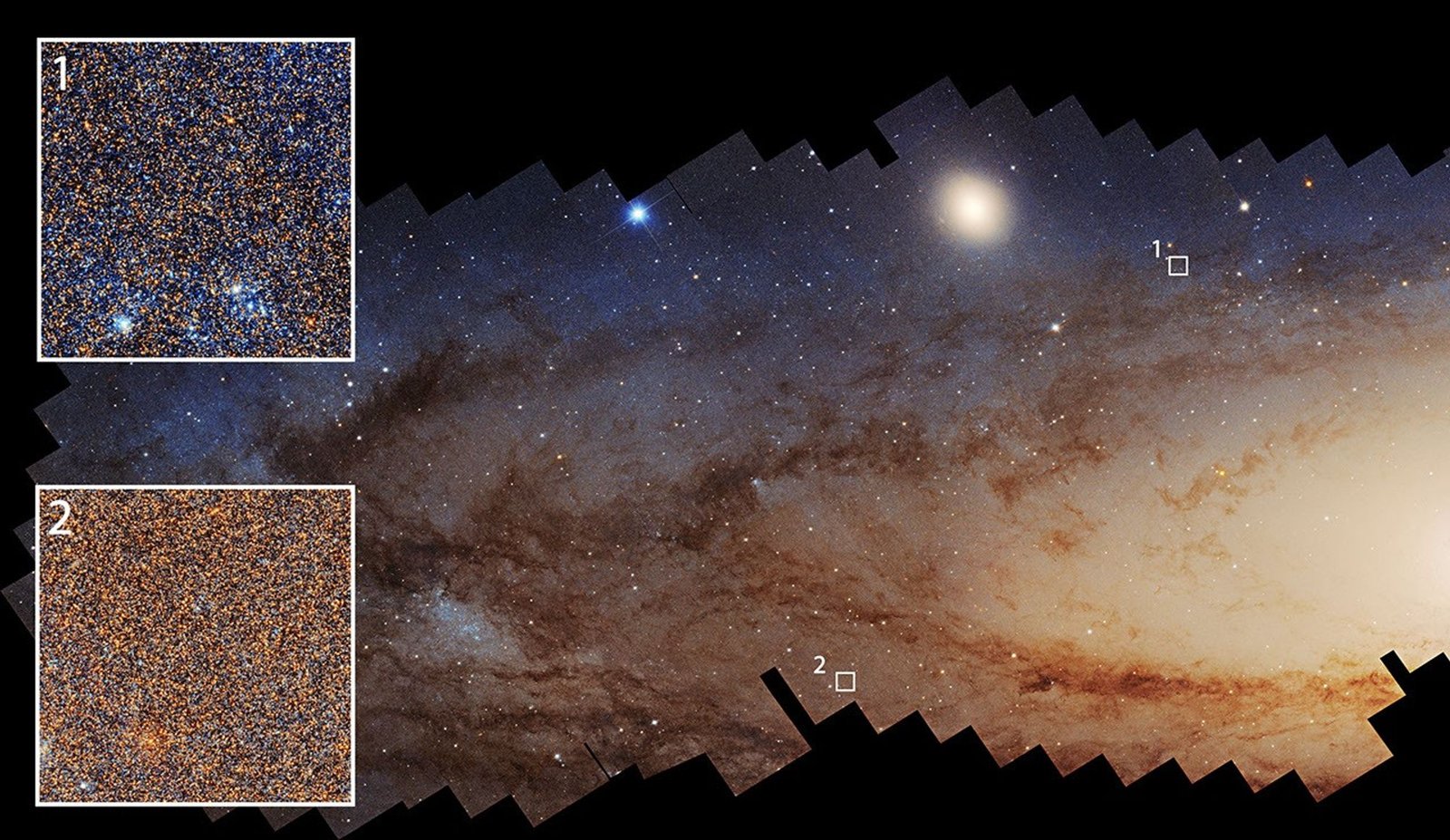
The Milky Way and Andromeda are moving relative to one another, but a future collision is not certain. A 2025 study combining Hubble and Gaia observations with large sets of simulations estimated roughly a 50% chance of a collision within the next 10 billion years. The result replaced the older assumption that a merger was almost inevitable. The long-term outcome remains uncertain and depends on the motions and gravitational influence of other members of the Local Group. NASA explains the revised collision outlook.
Many large galaxies contain a supermassive black hole at their centre. The black hole itself does not shine, but gas falling toward it can form a hot, rapidly moving accretion disc. Friction and magnetic processes in this environment can release enormous amounts of energy.
When a galaxy’s central region is especially active, it is called an active galactic nucleus (AGN). Some AGN produce powerful jets that extend far beyond the galaxy. Quasars are among the most luminous examples of active galactic nuclei. Their brightness allows astronomers to observe them across vast cosmic distances.
Simplified active galactic nucleus. Not all galaxies are active, and not every active nucleus launches large jets.
Scientists are still investigating how supermassive black holes formed so early in cosmic history, how they grow alongside their host galaxies and how feedback from active nuclei influences the gas that forms stars.
Galaxies are organised into larger structures. A small collection of galaxies bound together by gravity is called a group. A cluster is a much larger and more massive system containing many galaxies, hot gas and dark matter. Clusters can interact and merge with one another, forming still larger structures.
On the largest scales, galaxies and clusters trace a cosmic web: a network of filaments, sheets and dense nodes separated by vast cosmic voids. Dark matter provides much of the gravitational scaffolding in which this large-scale structure develops.
An abstract representation of the cosmic web, not a map of actual galaxy positions.
Galaxies are too distant for astronomers to examine directly, but their light carries information about their stars, gas, dust, motion and distance. Observations across the electromagnetic spectrum reveal different parts of a galaxy’s story.
Redshift is especially important in extragalactic astronomy. As the universe expands, light travelling across cosmic distances is stretched to longer wavelengths. Measuring this shift, together with other distance indicators and models, helps astronomers reconstruct how galaxies have changed over cosmic time.
Looking far away means looking back in time. Light takes time to travel. When astronomers observe a distant galaxy, they see it as it was when the light began its journey—not as it exists at the present moment.
Galaxy motions and gravitational lensing point to unseen mass, but the physical nature of dark matter remains unknown.
Researchers are investigating how early gas clouds, the first stars and dark matter assembled into the earliest galactic systems.
The relationship between supermassive black holes, gas flows and star formation is complex and remains an active field of research.
Gas supply, heating, environment and feedback can all contribute to the decline of star formation, but their relative importance varies.
A galaxy is a gravitationally bound system of stars, stellar remnants, gas, dust and dark matter.
Common broad categories include spiral, elliptical, lenticular and irregular galaxies. Dwarf galaxies form another important population and can have different shapes.
The exact number is not known. Estimates for the observable universe depend on observations, models and how faint or small galaxies are counted.
A solar system is a star and the objects gravitationally bound to it. A galaxy contains enormous numbers of stars and their systems, along with gas, dust and dark matter.
Yes. Galaxies move under gravity within groups, clusters and the expanding universe. They can orbit, interact and merge.
Yes. Galaxies can pass close to one another and merge. Direct collisions between individual stars are rare because stars are separated by vast distances.
Many large galaxies are known to host central supermassive black holes, but astronomers are still investigating how common they are across all galaxy types and masses.
The Milky Way is the galaxy that contains our Solar System. It is a barred spiral galaxy with a central bulge, a disc, spiral structure and an extended halo.
Discover how stars live and die, how extreme objects shape galactic centres and how the universe’s large-scale structure developed.
These institutional resources provide further context: