Address
304 North Cardinal St.
Dorchester Center, MA 02124
Work Hours
Monday to Friday: 7AM - 7PM
Weekend: 10AM - 5PM

Address
304 North Cardinal St.
Dorchester Center, MA 02124
Work Hours
Monday to Friday: 7AM - 7PM
Weekend: 10AM - 5PM

Explore the mysteries of dark matter and dark energy: the gravitational evidence, leading scientific explanations, cosmic expansion and the questions that remain unanswered.
Most of the universe is hidden from direct view. Galaxies move as though more matter is present than telescopes can see, while the expansion of the universe is accelerating for reasons we do not yet understand. These are two different mysteries—and together, they are reshaping our picture of the cosmos.
Stars, planets, gas, dust and everything made of atoms belong to ordinary matter. Yet measurements of the universe indicate that ordinary matter accounts for only a small fraction of its total energy budget. The standard cosmological model, known as Lambda-CDM (ΛCDM), describes the present-day universe as containing roughly 5% ordinary matter, 27% dark matter and 68% dark energy.
A conceptual illustration. The halo and cosmic web are inferred from observations and models; dark matter and dark energy are not directly photographed in this way.
Atoms: stars, planets, interstellar gas, dust and life. This is the material that emits, absorbs or reflects light.
A form of matter inferred from gravity. It does not appear to emit, absorb or reflect light in the way ordinary matter does.
The name given to the unknown component associated with the accelerated expansion of the universe.
They are approximate fractions of the universe’s total mass-energy density in the ΛCDM model—not a count of objects or a direct inventory. The estimates depend on cosmological measurements and the model used to interpret them.
Keep the two mysteries separate: dark matter behaves like an additional gravitating component that helps structure form. Dark energy is associated with the changing expansion of space on cosmic scales. The names sound related, but the evidence points to different roles.
Dark matter was not proposed because astronomers saw a faint new object. The case emerged because the gravitational behaviour of galaxies and galaxy clusters did not match what visible matter alone could explain. Something unseen appeared to contribute additional gravity.
Stars orbit the centres of galaxies. If the visible stars and gas were the only significant sources of gravity, the orbital speeds far from a galaxy’s centre would generally be expected to decline. Instead, many observed galaxies have rotation curves that remain relatively flat over large distances. This suggests that mass extends well beyond the bright regions we can see.
Simplified illustration of a common rotation-curve pattern. Real galaxies vary, and astronomers model both visible and unseen mass.
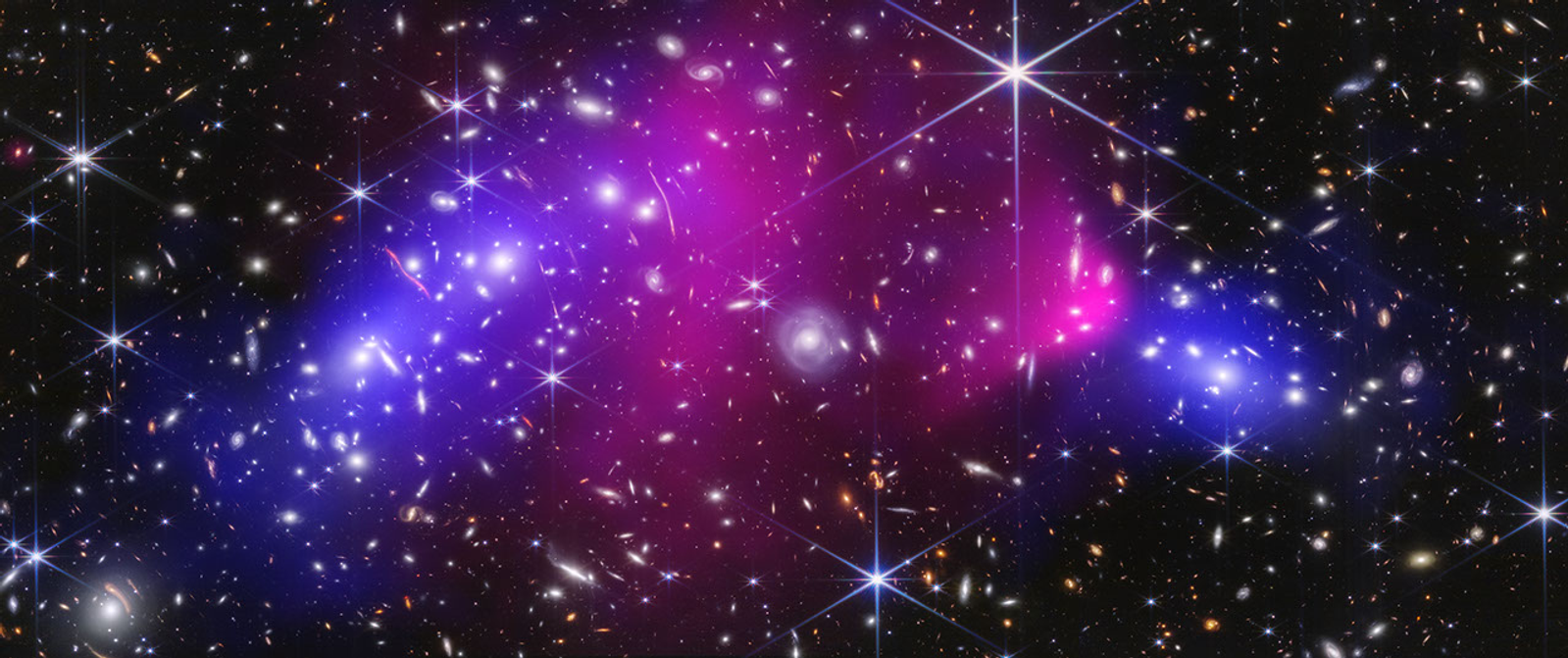
Gravity can bend the path of light. When light from a distant galaxy passes a massive foreground galaxy or cluster, the foreground mass can distort, magnify or split the background image. This effect—gravitational lensing—lets astronomers map mass that may not shine. In many systems, the inferred mass is greater and more extended than the visible matter can account for.
Galaxy clusters contain hot gas, galaxies and additional unseen mass. The motions of galaxies within clusters, the temperature and distribution of the gas, and lensing measurements together indicate more gravitating mass than the luminous material supplies. Measurements of the cosmic microwave background (CMB) and the growth of large-scale structure also support a universe containing a substantial dark matter component.
Evidence is not the same as identification. Multiple independent observations support the gravitational influence of dark matter. They do not yet tell us exactly what dark matter is made of.
Dark matter must fit a demanding set of clues. It needs to behave gravitationally in ways consistent with galaxy formation, clusters, lensing and the CMB. It also appears to be largely non-luminous and, in the standard picture, mostly non-relativistic when cosmic structures form.
Weakly interacting massive particles are hypothetical particles that could interact through gravity and perhaps other very weak interactions. Many experiments have searched for them, but no confirmed detection has emerged.
Axions are hypothetical very light particles originally proposed in particle physics. They are also candidates for dark matter, and specialised experiments are searching for possible signals.
Some extensions of particle physics propose neutrino-like particles that interact even more weakly than known neutrinos. They remain hypothetical dark matter candidates.
Researchers investigate other particle candidates and alternative descriptions. No candidate has yet been established as the identity of dark matter.
Experiments take several approaches: detectors deep underground try to catch rare interactions; observatories look for possible signals from space; and particle accelerators test whether new particles can be produced. Astronomers also keep refining measurements of galaxies, clusters and the early universe.
It is important not to assume the answer in advance. Dark matter may be a new particle, a collection of particles, or something that requires a different theoretical description. The evidence for an unseen gravitational component is much stronger than the evidence for any one proposed identity.
The universe has been expanding since its early hot, dense state. In the late twentieth century, observations of distant Type Ia supernovae provided evidence that cosmic expansion is accelerating rather than gradually slowing under gravity alone. Other observations, including the CMB and the large-scale distribution of galaxies, help build and test the same broad picture.
To describe this acceleration within cosmology, scientists use the term dark energy. It is not a confirmed substance that has been collected or directly observed in a laboratory. It is the name for the unknown component—or, more broadly, the missing explanation—associated with the accelerated expansion in our cosmological model.
A simplified illustration of cosmic expansion. It does not show galaxies flying outward from a central point into pre-existing empty space.
Einstein’s equations allow a term called the cosmological constant, represented by the Greek letter Λ (Lambda). In the standard ΛCDM model, it acts like a constant energy density associated with empty space and can account for the observed acceleration. This is currently the simplest widely used description, but it does not explain why the value is what it is.
Some models propose that dark energy is dynamic and may evolve as the universe ages. One broad family of ideas is called quintessence. Other proposals modify our understanding of gravity on the largest scales. These possibilities are active research questions, not established replacements for ΛCDM.
Where the evidence stands (2026): recent DESI and Dark Energy Survey analyses have reported a preference for models in which dark energy may evolve over time when several datasets are combined. The strength of that preference depends on the datasets and model assumptions; other analyses remain consistent with a cosmological constant. This is an active hint, not a confirmed discovery. See the Dark Energy Survey Year 6 results and DESI’s July 2026 update.
A careful distinction: dark energy is not simply a repulsive force pushing galaxies through space. In the standard model, it is associated with the dynamics of spacetime and the expansion of the universe itself.
Their names can make them sound like two versions of the same thing. They are not. The observations they help explain, and the roles they play in cosmic history, are different.
| Question | Dark matter | Dark energy |
|---|---|---|
| What is it used to explain? | Extra gravitational influence in galaxies, clusters and structure formation | The observed acceleration of cosmic expansion |
| How is it inferred? | Galaxy motions, gravitational lensing, clusters, CMB and structure growth | Supernova distances and other measurements of cosmic expansion and structure |
| What does it do in the standard picture? | Clumps gravitationally and helps build cosmic structure | Has a smooth, dominant effect on expansion at late cosmic times |
| Do we know its nature? | No confirmed particle or identity | No confirmed underlying physical explanation |
Dark matter helps matter gather into galaxies and the cosmic web. Dark energy, as modelled in ΛCDM, becomes increasingly important in the universe’s expansion history as the cosmos grows older. They are both central to modern cosmology, but they are not interchangeable.
Is it one particle or several? Does it interact through forces beyond gravity? Why have direct searches not yet found a definitive signal?
If it is the cosmological constant, why is its energy density so small compared with some theoretical expectations?
Could its influence change with time? More precise measurements of expansion and structure may help distinguish models.
Are the observations pointing to unseen components, new physics, or a refinement of gravity on cosmic scales? Competing ideas must explain the full range of evidence.
New surveys map billions of galaxies, measure supernova distances, study weak gravitational lensing and examine the CMB with increasing precision. Particle experiments and astrophysical observations search for dark matter from different directions. No single measurement is likely to settle every question; progress comes from testing whether independent lines of evidence fit together.
These mysteries are not distant curiosities. Dark matter is part of the explanation for how galaxies and large-scale structures formed. Dark energy shapes the universe’s long-term expansion history. Together, they influence our account of where cosmic structure came from and how the universe may evolve.
They also expose the limits of our current theories. The Standard Model of particle physics does not provide an established dark matter identity, while the physical nature of dark energy remains unknown. Connecting cosmology, particle physics and gravity may require discoveries that change our understanding of nature.
The honest story is not that scientists have solved the dark universe. It is that several powerful, independent observations reveal that our visible inventory is incomplete—and researchers are building better tests to discover what is missing.
Dark matter is an unseen component inferred from its gravitational effects. It helps explain the motions of galaxies, gravitational lensing, galaxy clusters and the formation of cosmic structure. Its physical identity is not yet known.
Dark energy is the name given to the unknown component associated with the accelerated expansion of the universe. The cosmological constant is the simplest description in the standard model, but the underlying nature remains unresolved.
No. Dark matter behaves like a gravitating matter component that clumps and helps form structure. Dark energy is associated with the accelerated expansion of space on cosmic scales.
Not directly with ordinary telescopes. Astronomers infer its presence through gravity, including its effects on galaxy motions and the bending of light. A definitive direct detection of a dark matter particle has not been confirmed.
In the standard ΛCDM model, approximate present-day values are 27% dark matter and 68% dark energy, with about 5% ordinary matter. These are model-based estimates of the cosmic mass-energy budget.
That phrase is a shorthand, but it can mislead. In the standard cosmological model, dark energy is associated with accelerated expansion of space; it is not a conventional force acting like an explosion from a central point.
No. WIMPs, axions and other candidates are being investigated, but none has been confirmed as the substance responsible for the dark matter evidence.
Possibly. The cosmological constant model treats it as constant, while some alternative models propose a changing component. Observations are continuing to test whether the data favour one description.
Explore the ideas that help explain how the universe is built, how it evolved and how gravity reveals what light cannot show us.