Address
304 North Cardinal St.
Dorchester Center, MA 02124
Work Hours
Monday to Friday: 7AM - 7PM
Weekend: 10AM - 5PM

Address
304 North Cardinal St.
Dorchester Center, MA 02124
Work Hours
Monday to Friday: 7AM - 7PM
Weekend: 10AM - 5PM

Explore nebulae, star clusters, galaxy groups and clusters, the cosmic web, voids and powerful phenomena such as supernovae, gravitational lensing, relativistic jets and gravitational waves.
The universe is not a scattering of isolated stars and galaxies. It is threaded with glowing clouds of gas, gathered into clusters, stretched into immense filaments and separated by vast cosmic voids. Across these structures, powerful events—from stellar explosions to gravitational lensing—reveal how matter, energy and gravity shape the cosmos.
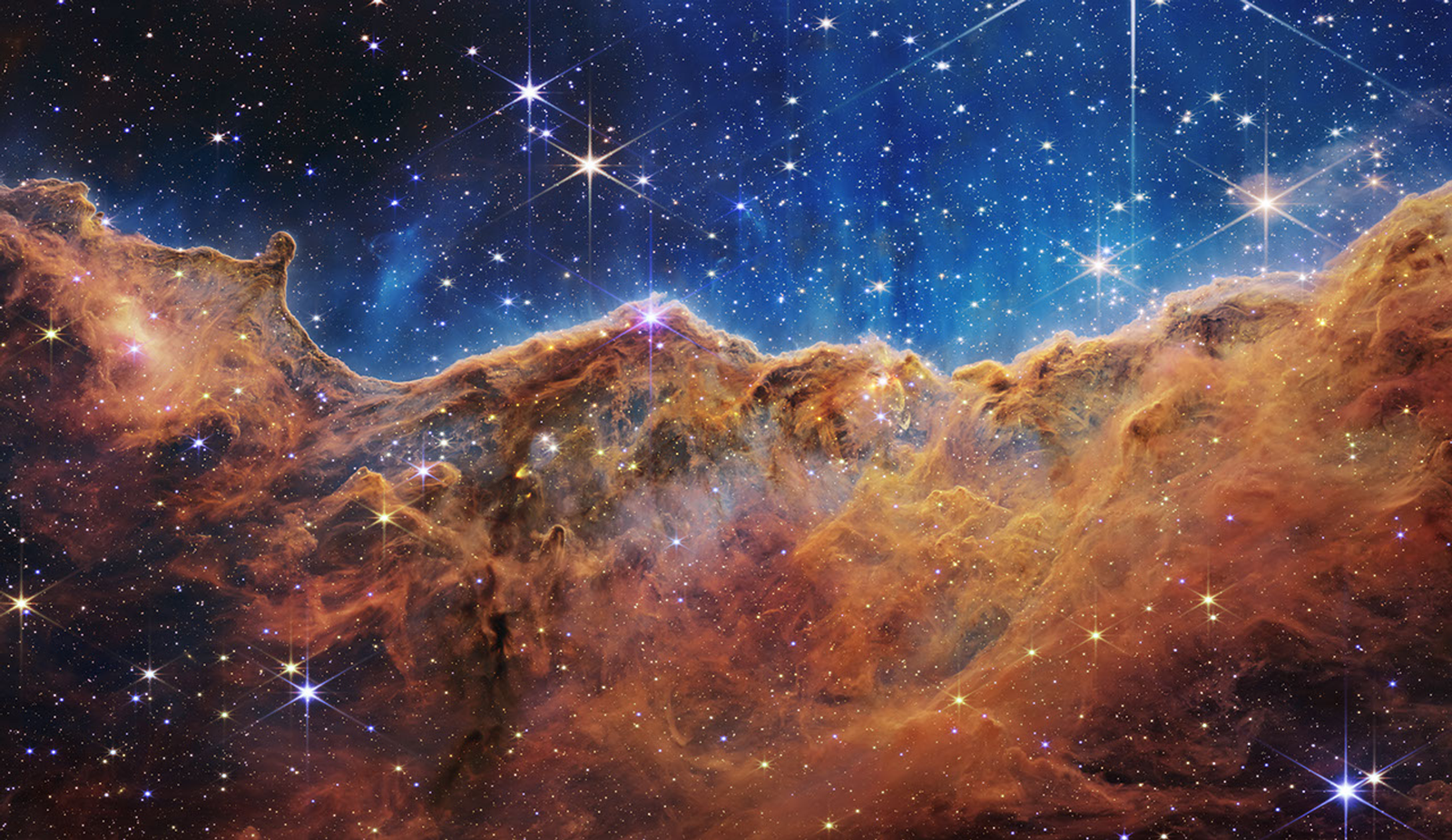
Look close enough and space is full of structure. Clouds of gas and dust give birth to stars. Stars gather into clusters and galaxies. Galaxies collect in groups and clusters, which themselves are connected by enormous filaments. Between these dense regions lie cosmic voids, where galaxies are comparatively sparse.
These structures are not separate pieces assembled like a machine. They emerged and evolved under gravity from small differences in the density of matter in the early universe. The expansion of the universe, the motion of gas, star formation and the influence of dark matter all contribute to the patterns astronomers observe today.
A simplified, conceptual cosmic web. Real cosmic structure spans immense distances and is mapped statistically using galaxy surveys and other observations.
A nebula is an interstellar cloud of gas, dust or both. Some nebulae are regions where stars are forming; others are material illuminated or shaped by stars; still others are expanding remains of stellar explosions. Their colours and shapes can be spectacular, but the underlying physics is about radiation, gravity, chemistry and the movement of gas.
Gas glows after being energised by radiation from nearby hot stars. Hydrogen often produces prominent red emission, while other elements contribute different spectral lines and colours.
Dust scatters light from nearby stars rather than producing most of the visible light itself. Their appearance depends on the illuminating stars and the properties of the dust.
Dense clouds of dust block visible light from objects behind them. These cold regions can contain the molecular gas from which stars and planetary systems eventually form.
When a Sun-like or intermediate-mass star reaches the end of its life, it can shed its outer layers. The exposed hot stellar remnant illuminates the expanding gas. Despite the name, planetary nebulae have nothing to do with planets forming.
These are expanding structures of gas and energetic particles left after a supernova. Shock waves heat and compress surrounding material, while magnetic fields and fast particles produce radiation across the spectrum.
Cold molecular clouds can fragment and collapse under gravity. New stars form within them, often illuminating and reshaping the surrounding gas through radiation, winds and outflows.
Nebulae are closely connected to the life cycles of stars: they can be the birthplace of stars, the material returned by ageing stars, or the aftermath of stellar explosions. The gas and dust recycled through these processes help supply future generations of stars and planets.
Stars are often born in groups from the same molecular cloud. Some remain gravitationally bound for millions or billions of years; others disperse into the wider galaxy. Star clusters help astronomers compare stars that formed at roughly the same time and from similar material.
Relatively loose collections of stars, often containing tens to thousands of members. Their stars can gradually spread into the galactic disc as gravitational encounters and the galaxy’s tidal field reshape the group.
Dense, roughly spherical systems containing many thousands to millions of stars. Many are ancient and orbit in the halos of galaxies. Their stellar populations preserve clues about early galactic history.
Clusters are not simply decorative groupings. Their ages, chemical compositions and motions provide evidence about when and where stars formed, how galaxies assembled and how stellar systems evolve.
Galaxies are not distributed randomly through space. Gravity gathers them into larger associations, producing a hierarchy of structures. The largest patterns are often described as the cosmic web: a network of filaments and sheets surrounding enormous underdense regions.
Small associations of galaxies held together by gravity. Our Milky Way belongs to the Local Group, which also includes the Andromeda Galaxy and many smaller galaxies.
Much larger gravitationally bound systems containing hundreds or thousands of galaxies, hot gas between galaxies and substantial amounts of dark matter.
Extensive regions containing multiple galaxy groups and clusters. Some named supercluster structures are not fully gravitationally bound as a single object; their parts participate in the continuing expansion of the universe.
Long strands and broad walls of matter that connect dense nodes in the cosmic web. Galaxies and gas move along these structures under gravity.
Large regions with far fewer galaxies than average. Voids are not perfectly empty: they can contain diffuse matter, gas and occasional galaxies.
Dark matter does not shine, but its gravitational influence helps shape the distribution and growth of cosmic structure. Galaxies and clusters form within this larger gravitational framework.
To explore galaxies themselves—their shapes, internal structure, growth and mergers—continue to the Galaxies topic. The cosmic web describes how galaxies are arranged on much larger scales.
Structures evolve through processes that can release enormous amounts of energy or reveal the geometry of spacetime. Some phenomena unfold over seconds; others shape their surroundings for millions of years. Astronomers study them through light, particles, neutrinos and gravitational waves.
Explosive stellar events that can occur when certain stellar cores collapse or when a white dwarf undergoes a thermonuclear runaway. They disperse newly made elements and drive shock waves into surrounding space. The mechanisms differ between supernova types.
Mass curves spacetime and bends the paths of light. A massive galaxy or cluster can magnify, distort or multiply the images of more distant objects. Lensing also helps map mass that does not emit detectable light.
Some systems containing accreting black holes or neutron stars launch narrow outflows of particles moving at speeds close to light. Magnetic fields and the environment around the compact object are central to how these jets form.
Brief flashes of high-energy gamma rays associated with some massive-star collapses and compact-object mergers. They can be detected across cosmological distances and are among the most energetic transient events known.
Ripples in spacetime generated by accelerating masses, detectable in especially strong signals from compact-object mergers. They provide a way to observe cosmic events that may be faint or invisible in ordinary light.
High-energy charged particles arriving from space. Their paths are bent by magnetic fields, making it difficult to trace them directly to their sources. Supernova remnants and other energetic environments are important candidate accelerators.
No single telescope reveals the whole universe. Different wavelengths and messengers expose different components of the same environment. Visible light traces stars and galaxies; infrared can reveal cooler dust and distant galaxies; radio observations map gas and energetic particles; X-rays reveal extremely hot gas and energetic processes.
Images and spectra reveal stars, nebulae, galaxies, dust and the chemical fingerprints of matter. Infrared observations can see through some dusty regions and detect light stretched by cosmic expansion.
Radio telescopes trace cold gas, magnetic fields and energetic particles. Microwave observations include the cosmic microwave background, a crucial record of the early universe.
High-energy observatories study hot cluster gas, supernova remnants, compact objects, jets and explosive transients.
Large galaxy surveys map the distribution of matter across enormous volumes. Computer simulations test how gravity, gas physics and cosmic expansion could produce the structures we observe.
By combining these approaches, researchers can compare visible matter with its gravitational effects and reconstruct how cosmic structures formed and changed over time.
Cosmic structures are records of the universe’s history. Nebulae show how stars form and return material to space. Clusters preserve evidence of galaxy assembly and dark matter. The cosmic web records the growth of density patterns over billions of years. Explosive and relativistic phenomena test the laws of physics under conditions far beyond terrestrial laboratories.
They also connect the very small to the very large. The chemistry of a nebula depends on atoms forged inside stars; the motion of a galaxy cluster depends on gravity and dark matter; the shape of the cosmic web reflects the expansion history of the universe.
Images of cosmic structures are not always literal colour photographs. Astronomers often combine wavelengths, map invisible signals or assign visible colours to data so that different physical processes can be distinguished. The method behind an image matters as much as its appearance.
A nebula is a cloud of gas, dust or both in space. Some are sites of star formation; others are illuminated clouds or material shed by dying stars and stellar explosions.
Some are. Cold, dense molecular clouds can collapse under gravity to form stars, but not every nebula is a star-forming region. Some are the remains of stars that have reached the end of their lives.
It is the large-scale pattern of matter in the universe: galaxies and clusters arranged in filaments and sheets around vast underdense voids.
No. They contain less matter and fewer galaxies than average, but they are not perfectly empty. Diffuse gas, dark matter and some galaxies can still be present.
Groups are generally smaller associations of galaxies; clusters are larger, more massive systems containing many galaxies, hot gas and dark matter. The boundary between categories is not defined by one universal galaxy count.
Mass curves spacetime, changing the paths that light follows. A foreground object can therefore magnify or distort the image of a more distant source.
No. A supernova is the explosive event. A supernova remnant is the expanding material and shock structure left behind as the ejecta interact with their surroundings.
They map the positions and distances of galaxies in large surveys, combine these with observations of gas and gravitational effects, and compare the resulting patterns with cosmological simulations.
Cosmic structures connect the lives of stars, the evolution of galaxies and the large-scale history of the universe. Follow these related subjects to explore each layer in greater depth.
For further reading, start with these resources from NASA: